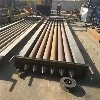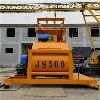

A precast production facility of approximately 500,000 square metres was completed at the NEOM development in January 2026, built to serve the giga-project's modular construction programme. Its scope is the clearest available picture of what Gulf precast investment now looks like at scale: 16 kilometres of internal roads, 28 kilometres of rail infrastructure for gantry and overhead crane operation, three batching plants, seventeen precast buildings on grade, thirty-five prefabricated buildings and three large-span steel sheds.
That is a single facility. It is worth reading in detail because the same pattern - very large, crane-served, batching-integrated production yards - is being repeated across the region, and because the equipment and section decisions it implies are different from those of a conventional precast plant. This article sets out the 2026 Gulf data and what it means for the machines inside those yards.
Where the Gulf market stands in 2026
The regional figures move at a modest rate by the standards of the announced project values, which is the first point worth understanding: the commitments are enormous, but the market they create grows steadily rather than in a step change.
Saudi Arabia accounts for more than half of regional precast demand, which means the regional average is largely a statement about Saudi Arabia. Producers targeting the wider Gulf should plan on the Saudi growth rate being the one that sets the pace of competitor investment.

The element mix: floors and roofs lead
Published 2025 segmentation for the Saudi market is unusually specific, and it maps directly onto machine categories.
Structural building components as a group hold around 46% of the market, with architectural components and transport products making up most of the balance. The practical reading is that floor elements are the single largest product family in the region, which is why hollow core and prestressed floor plate capacity has been the first investment in almost every new Gulf yard.

What a 500,000 square metre yard tells you
The scope of that facility is instructive because it shows what a production unit sized for giga-project volumes actually contains.
Three batching plants serving one production area is the number worth pausing on. It indicates that concrete supply, not forming capacity, is treated as the limiting resource - a plant that can form faster than it can supply concrete is a plant with idle forming equipment. The same logic applies at any scale: batching capacity is the first thing to size correctly and the last thing producers think about.
Twenty-eight kilometres of rail for gantry and overhead cranes indicates that handling is designed into the yard rather than added to it. At high volumes the movement of moulds, elements and curing racks is a larger labour consumer than the casting operation itself, and yard layout determines whether that labour can be reduced.
Seventeen precast buildings and thirty-five prefabricated buildings inside the production facility itself is a reminder that the plant is a construction project as well as an industrial one. For a supplier, it means the equipment has to be specified against a staged installation, because the forming lines are commissioned before the yard is complete.

Housing programmes and the volume behind them
Giga-projects attract attention, but the residential pipeline generates the repeat volume. Saudi Arabia has committed to delivering over a million residences, more than 362,000 hotel rooms, over 7.4 million square metres of retail space and 7.7 million square metres of new office space by the end of the decade, with home ownership targeted at 70% by 2030 against a level around 64% in 2024.
Housing at that scale is not delivered by conventional methods within the available labour pool, and labour availability is the second driver in the region behind project scale. A cast-in-place housing programme needs a large on-site workforce that the Gulf market has difficulty recruiting and retaining; a factory-finished element programme moves that labour into a controlled environment where a smaller, trained crew can produce a predictable number of pieces per shift.
The hospitality pipeline adds a third stream. Modular and Volumetric additions to existing hotels are being used to add capacity quickly, which creates demand not only for structural elements but for the standardised floor, wall and service modules that sit inside them.

Regulatory change: whole-life accountability
Dubai introduced building quality and safety legislation in 2026 that extends monitoring across the whole lifecycle of a building, with periodic certificate renewal rather than a one-off approval at completion. Combined with national green building rating schemes and net-zero commitments, the effect is that the performance of an element after handover becomes commercially relevant to the party that made it.
For a precast producer this changes what a quality record is for. Durability, thermal performance and dimensional consistency stop being production preferences and become criteria the buyer can hold you to years later. Practically, it means the machine specification should be defensible on repeatability: a forming machine whose vibration can be set and recorded, a mould set whose wearing surfaces are measured on a schedule, and a curing arrangement that produces a record rather than a habit.

Heat, sand and the equipment consequences
The Gulf environment imposes three constraints that are specified rather than adjusted.
- Ambient temperature. High temperatures shorten the workable window and accelerate early strength gain, which affects stripping intervals, curing regimes and the behaviour of the mix at the forming head. A plant specified for a temperate climate will not reproduce the same section in August.
- Abrasive aggregate and sand ingress. Working surfaces, forming tubes and drive components wear faster in a dusty environment. Machines with accessible, replaceable wearing parts cost less per cubic metre over a five-year horizon than machines with integrated surfaces.
- Multi-shift operation. Giga-project schedules commonly run the plant harder than a commercial producer would. Machines specified for single-shift duty will not deliver multi-shift availability without maintenance access designed in.
Frequently asked questions
Which precast element has the most demand in the Gulf?
Floor and roof elements, including hollow core slabs and prestressed floor plates, are the largest single family at around 39% of the Saudi market by segment. Structural components overall hold about 46%. For a new yard, floor forming capacity is normally the first line installed because it serves both housing and commercial construction.
Why are batching plants so prominent in Gulf precast yards?
Because concrete supply, not forming speed, sets the ceiling on plant output. A yard with three batching plants for one production area is sized so that the forming lines never wait for concrete. In a hot climate the workable window is shorter, which makes continuous supply more important rather than less.
Does the Gulf require a particular product standard for precast?
Requirements are set project by project and increasingly by national regulation, with durability, thermal performance and lifecycle accountability carrying more weight than they did a decade ago. The practical approach is to establish what the project specification requires before the mould is designed, because cover, mix and curing are decided there rather than at the machine.
Can a plant outside the Gulf supply elements into it?
For heavy elements, shipping cost usually makes it impractical beyond a certain distance, which is why production is being built locally and why equipment supply is the export opportunity. Machines ship as frame and mould components and are assembled in-country.
Technical conclusion
The Gulf precast market is growing at around six to seven per cent a year from a substantial base, and the composition of that demand is unusually clear: floor elements first, structural components second, with housing programmes rather than giga-projects carrying the repeat volume. The scale of individual facilities - half a million square metres in a single yard - sets the standard that regional buyers now measure against.
Three equipment decisions follow from the market data. Batching capacity has to be sized above forming capacity, because concrete supply is the real limit. Wearing parts have to be replaceable and accessible, because the environment is abrasive and the duty cycle is multi-shift. And the section the machine can hold has to be verifiable in high ambient temperatures, because that is where the specified tolerances are hardest to achieve.
What we supply
We manufacture the forming equipment that the region's product mix requires. The hollow core slab extruder and the push-method hollow core slab machine cover the largest element family, with the hollow floor machine for floor plate production where a different section is required. For the envelope and infill work that follows the frame, the cement wall panel machine.
Batching and mixing equipment is supplied as part of the same package, sized against the forming output rather than offered as a separate item. The full range is listed under slab machine. Every machine is built to order, load tested before shipment, and dispatched with the test record and a spare parts list covering the wearing components.
Next step
Send us the element section your project requires, the daily output the programme demands, and the ambient conditions at your site. We will come back with the machine specification, the batching capacity it needs behind it, and the maintenance access the wearing parts require on a multi-shift duty cycle.
Section drawings and project specifications can be sent through the contact page. If the project carries a specific durability or lifecycle requirement, tell us - it is a mould and mix input, and it is decided before the machine is built.