
Every precast plant that makes hollow core slabs eventually faces the same decision: which forming method should the next machine use. The three mainstream methods - extrusion, push-extrusion and internal vibration molding - produce slabs that look similar on the finished pile but behave very differently in daily operation, in mould cost and in what happens when concrete quality drifts.
This article compares the three methods on the dimensions that actually affect your production plan: achievable slab section, output rate, core forming method, mould and spare-part behaviour, and the type of plant each one suits. All machine specifications quoted here are from our own manufacturing range, so you can map the numbers directly onto a purchasing decision.
What a hollow core slab machine actually does
A hollow core slab machine is a moving forming machine. It travels along a casting bed, receives concrete from a hopper, compacts it, and leaves behind a continuous slab with longitudinal voids. The voids reduce self-weight while keeping bending stiffness, which is why hollow core slabs dominate floor systems in residential and industrial buildings.
The machine does three jobs at once: it forms the outer section, it creates the cores, and it compacts the mix. Different machine types solve that third job - compaction - in fundamentally different ways. That single difference drives almost everything else.

The three forming methods at a glance
The table shows where the real trade-off sits. Extrusion gives the highest continuous output and the widest section range. Push-extrusion gives a fixed, dense section. Internal vibration molding gives the greatest flexibility in slab thickness and core diameter, because the core tubes can be changed.
Method 1 - Extrusion: highest output, widest section range
An extrusion machine uses augers to push concrete through a forming head while compacting it against the sides. Core-forming mandrels sit inside the head, so the cores are created in the same pass that forms the outer surface. Our extrusion range is built around the hollow core slab extruder platform, which covers the five sections listed below.
Where extrusion wins: volume work. If your order book is dominated by one or two slab sections and you need meters on the bed, extrusion is the most direct route. Because the section is set by the forming head, machine weight scales with section size - a 220×1200 head assembly is roughly three and a half times the weight of a 120×600 unit, which matters for bed design and for how you move the machine.
Where extrusion needs discipline: the mix. Extrusion relies on the concrete being stiff enough to hold its shape immediately after the head passes, but workable enough for the augers to move it. A mix that is too wet produces slumping and core collapse; too dry and the augers stall. This is the single most common production problem we are asked about, and it is a mix-design issue rather than a machine fault.

Method 2 - Push-extrusion: dense section, low maintenance structure
Push-extrusion compacts the mix with a reciprocating ram against a fixed mould rather than with augers. The mould defines the section completely, which is why push-extrusion machines produce a very consistent outer profile and a dense surface.
Both models share the same slab geometry and can be built to a custom section on request. The difference between them is drive power: the Type 180 carries a larger main motor, a larger vibrator and a heavier gearbox, which is what you want when slab length, section density or local aggregate grading put more load on the compaction stroke. Full details of the push-extrusion slab machine range are on the product page.
Where push-extrusion wins: wear behaviour. Driven by a ram and a fixed mould rather than by continuously rotating augers, the working parts see a different wear pattern, and plants that run high volumes with abrasive aggregates often report lower day-to-day maintenance on push-extrusion units than on extrusion units.
Where push-extrusion is limited: section flexibility. The mould fixes the geometry, so changing slab section means changing the mould rather than adjusting the head. If your product mix changes often, factor that in.

Method 3 - Internal vibration molding: the flexible option
Internal vibration molding uses vibrators mounted inside the core tubes. The outer surface is formed by the machine body while the core tubes vibrate the mix from the inside out. Because the core tubes are removable and interchangeable, this method handles a wider spread of slab thickness and core diameter than either extrusion or push-extrusion.
The Type 220 unit deserves a note. It was developed for the Central Asian market, where slab sections tend to be thicker and slab lengths longer than the standard European range, and where plants commonly work with sharp seasonal temperature swings. Its 11 kW motor, φ126 mm core tubes and 6.5–7.5 m slab length put it in a different operating class from the Type 120 and Type 180.
Where internal vibration wins: flexibility and surface quality control. Thickness changes are handled by changing core tubes rather than replacing a forming head, and vibration parameters can be adjusted to suit the mix. Slabs formed this way typically show a good surface finish, and the machine tolerates a slightly wider workability window than extrusion.
Where internal vibration needs attention: cycle time. Because it is a semi-automatic process with core-tube handling, throughput depends on how well the surrounding plant is organised - bed length, crane availability, demoulding sequence. The machine itself is rarely the bottleneck.
Choosing by slab section and plant type

Estimating your real daily output
Published output figures are a starting point, not a promise. Two plants with the same machine can differ by 30% or more. Work through these four factors before you commit to a machine size:
- Bed length and number of beds. A 600–800 m/day figure assumes continuous forming. If your beds total 80 m and you form one bed at a time, your day is a sequence of short runs with handling in between.
- Cycle time around the machine. Curing, cutting and demoulding determine how fast a bed is released. A machine that forms faster than your beds can be cleared will sit idle.
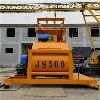
- Concrete supply. A slab machine consumes mix continuously while forming. Check that your mixer and batching setup can keep the hopper fed - this is often the hidden constraint, and it is the reason we usually quote slab machines together with mixing equipment such as the JS500 and JS750 twin-shaft mixers.
- Mix design and aggregate. Grading, cement content and admixtures change how the machine compacts. Cold-weather production in particular requires an adjusted mix and, in many cases, a curing plan.

Five mistakes we see most often
- Buying for the largest section "just in case." A heavier machine costs more to move, needs a stronger bed and consumes more power on every run - including the runs where you do not need the extra section.
- Treating output rate as a single number. Compare linear meters per productive hour, not per calendar day, when you compare machines.
- Ignoring the demoulding side. Core-tube handling and slab lifting dictate the real rhythm of a semi-automatic plant.
- Fixing mix problems with machine settings. Slumping, tearing and core collapse are usually mix-design or bed-condition issues before they are machine issues.
- Buying the machine without the spare-parts list. Wear parts on a slab machine are consumables. Knowing which they are, and having them in stock, is what keeps a plant running.
Frequently asked questions
What slab thicknesses can a hollow core slab machine produce?
With our extrusion range, from 120 mm up to 220 mm in thickness, with widths from 600 mm to 1200 mm. Internal vibration molding machines cover 120 mm to 220 mm thickness with core tube diameters from φ76 mm to φ126 mm.
What determines the price of a hollow core slab machine?
Four things dominate: the maximum slab section the machine must form, the compaction method, the drive and vibrator power needed for that section, and the accessories included in the quote - core tubes, spare forming parts, cutting and handling equipment. Machines for wide or thick sections carry substantially more steel and power than machines for narrow sections, so it is more useful to price against your target section than against a general machine class.
Can one machine produce more than one slab section?
On extrusion machines the section is set by the forming head, so a section change means a head change. Internal vibration molding machines are more flexible because core tubes and thickness are changed at the machine. If your product range is wide, tell us at the enquiry stage - we can configure the machine around the sections you actually sell.
How do I know whether a slab machine suits my plant before ordering?
Send us your target slab section, slab length, bed length, available power and the mixer you already run. We size the machine against those five inputs rather than against a catalogue class, and we will tell you if a smaller machine is the better fit.

Technical conclusion
There is no universally correct forming method - there is a correct match between method, section and plant layout. Extrusion gives the broadest section range and the highest continuous output. Push-extrusion gives a fixed, dense section with a favourable wear profile for high-volume, abrasive-aggregate work. Internal vibration molding gives the most flexibility in thickness and core diameter, and is the easiest of the three to reconfigure when your product mix changes.
Decide the slab section first. Everything else - machine weight, power, bed requirement, price band and spare-parts inventory - follows from that one number.
What we supply
We manufacture all three forming methods in-house, which means we can recommend against our own product when it is the wrong fit for your plant. Our range covers extrusion machines from GLY 120×600 up to 220×1200, push-extrusion machines in Type 120 and Type 180, and internal vibration molding machines in Type 120, Type 180 and the Type 220 unit developed for Central Asian conditions. We also supply the mixing, batching and handling equipment that surrounds a slab line, so the machine is sized against your whole production flow rather than in isolation.
Every machine is built to order. We test it under load before shipment and send you the test video, together with the spare-parts list matched to your machine. Slab machines are part of a wider precast equipment range that also includes the precast wall panel extruder and partition panel machines, so a complete production line can be configured from one supplier.
Next step
Send us four numbers and we will come back with a specific recommendation rather than a catalogue reference: (1) the slab section you need to form, (2) your typical slab length, (3) your total bed length, and (4) the mixer you already run. If you have not fixed the section yet, tell us the building type you are supplying - we will work back from that.
You can reach our engineers directly through the contact page, or review the full range on the slab machine category page.