



Truck Crane
What is Truck Crane
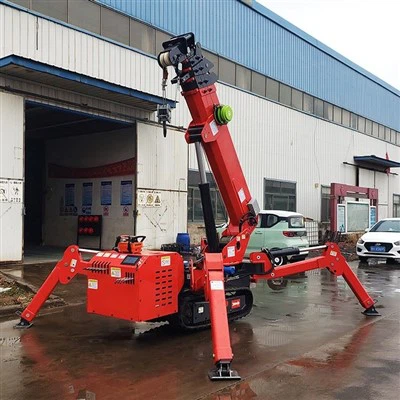
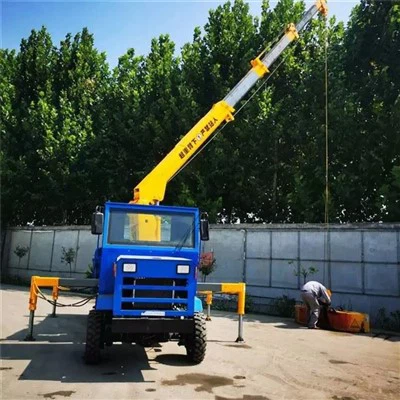
A truck crane is a lifting device on a standard or customized truck chassis, combining mobility with lifting capability. Designed to lift, lower, and transport materials across settings like construction sites, industrial projects, and logistics. Unlike stationary cranes, truck cranes travel on highways, moving between job sites without extra transport. This enhances utility, offering traditional crane power and truck mobility.
Enhanced mobility and accessibility
One of the primary advantages of using a truck crane is its mobility and accessibility. Unlike other types of cranes such as forklift trucks, and truck mounted cranes that may be stationary or require extensive setup time, truck cranes can travel anywhere a truck can go and are ready to work almost immediately. This feature makes them an ideal choice for construction projects that require lifting and transporting heavy loads to multiple locations.
Time and cost efficiency
Another advantage of using truck cranes is their time and cost efficiency. Because they can be quickly set up and taken down and require fewer personnel to operate, they can help expedite construction projects and reduce labor costs.
Versatility in lifting and transporting loads
Truck cranes are also highly versatile in their ability to lift and transport a wide variety of loads. They are capable of lifting heavy objects, such as steel beams and concrete slabs, as well as delicate items, such as art installations and glass panels.
Increased safety on construction sites
Truck cranes can help increase safety on construction sites. Because they are mobile and can be easily positioned to access hard-to-reach areas of construction sites, they can help reduce the need for workers to climb ladders or scaffolding to lift and transport materials.



Why Choose Us
Quality assurance
With stable quality, easy operation, long service life and convenient maintenance, they are deeply trusted by users. More than 40 varieties of building materials equipment, with sophisticated technology, advanced process standards and unified spare parts standards.
Good service
Parts are sent promptly and quickly, customer visits and technical guidance are accepted 24 hours a day, and lifelong maintenance services and spare parts are provided.
Production equipment
One 630kVA transformer, one 5T gantry crane, two intelligent boring machines, one intelligent planer, one large boring and planing machine, five welding robots, one 75kW diesel generator, one 16t truck crane, etc.
Production market
Our products are sold well in dozens of provinces, cities and regions across the country, and are exported to dozens of countries and regions including Russia, Uzbekistan, Thailand, Bangladesh, India, Nigeria, Malaysia, Indonesia, the Philippines, South Africa, etc.
How Does a Truck Crane Work?
Truck cranes operate by using a combination of hydraulics and cables to lift and transport loads. The operator sits in a cab located on the chassis and controls the crane's movements using a series of levers and switches. The crane's boom and jib can be extended and retracted to reach the desired height, speed, and distance, while the hoist can be used to lift and lower loads. Truck cranes are designed to be versatile and efficient, with the ability to perform a varied range of lifting tasks quickly and safely. They are also designed to be easy to operate, with most models featuring intuitive controls and user-friendly interfaces.
The Difference Between Truck Crane and Tower Crane
Tower cranes are another popular option for construction projects that require heavy lifting. However, they differ from truck cranes in their mobility and versatility. Tower cranes are typically stationary and require extensive setup time, making them better suited for larger construction projects with fixed locations. In contrast, truck cranes can travel anywhere a truck can go, making them an ideal solution for smaller construction projects or projects that require lifting and transporting materials to multiple locations. Another advantage of truck cranes over tower cranes is their ease of use. Truck cranes can be operated by a single person, while tower cranes require a team of trained professionals to operate and maintain.


The Difference Between Truck Crane and Crawler Crane
Crawler cranes are similar to truck cranes in that they are mobile and can travel over a wide variety of terrain. However, they differ in their lifting capacity, performance and cost. In contrast, truck cranes can be set up quickly and easily, allowing construction projects to proceed more efficiently.
The Difference Between a Truck Crane and a Telescopic Forklift
Telescopic handlers, also known as telehandlers, are another type of lifting equipment that is commonly used in construction projects. While they are versatile in their ability to lift and transport materials, they differ from truck cranes in their lifting capacity and mobility. Telehandlers tend to have a lower lifting capacity than truck cranes and are less mobile, making them better suited for smaller construction projects or projects with less demanding lifting requirements. Truck cranes are a versatile and mobile option for construction projects that require lifting and transporting heavy loads.

Key Factors to Consider When Choosing a Truck Crane
Load capacity and lifting height
When selecting a truck crane, it is important to consider its load capacity and lifting height. The load capacity refers to the maximum weight the crane is capable of lifting, while the lifting height refers to the maximum height the crane can reach. It is important to select a crane that is capable of handling the specific loads and lifting requirements of your project.
Terrain and site conditions
Another important factor to consider is the terrain and site conditions depending on where the crane will be used. If the site is uneven or has soft soil, a crane with a wider base and larger wheels may be necessary to ensure stability. Additionally, if the construction site has limited space or obstacles, such as overhead power lines or buildings, a crane with a shorter front boom length may be required.
Ease of operation and maintenance
When selecting a truck crane, it is also important to consider its ease of operation and maintenance. The right crane also should be easy to operate, with clear instructions and intuitive controls. Additionally, it should be easy to maintain, with readily available replacement parts and a reliable service network.
Local regulations and permit requirements
Finally, it is important to consider local regulations and permit requirements when selecting a truck crane. Different locations may have different weight and height restrictions and may require permits for certain types of lifting equipment. It is important to be aware of these regulations and ensure that the selected crane meets all applicable requirements.
Types of Truck Crane
Carry deck crane
A carry deck crane is great for getting into and out of small spaces, making it perfect for the later phases of construction when something must be moved into a tight location, such as an alleyway or access hall. They’re also very easy to set up and are capable of rotating a full 360 degrees, making them a workhorse on the job site. These small cranes are capable of lifting between 8 and 18 tons, depending on the model you select for rental. Combined with their size, this makes it easy to get them exactly where they’re needed.
Rough terrain cranes
Rough terrain cranes will often have four very large wheels on a compact body, making it easier to maneuver into difficult spaces or over rocks and other project site debris. Much like carry deck cranes, they can get into tight spaces, but unlike those cranes, they can also handle difficult terrain without the size limitations of all-terrain cranes.
All-terrain crane
Less compact than rough terrain cranes, all-terrain cranes have a four-wheel drive system paired with either a single engine or a pair of engines. Because they can be driven on public roads, there’s a seat belt installation requirement for the control system area. They can feature as many as nine pairs of wheels, with several of these pairs being able to turn to reduce the turning radius.
Crawler truck crane
Crawler truck cranes are laid out in a similar style to a carry deck crane, but feature tracks rather than tires. This provides superior all-terrain capability, especially on soft or fragile soils where tires may lose traction and tear up the surface further. The tracks also allow the crane to work in marshy areas where the ground may be damp because it spreads out the crane’s weight across the entirety of the tracks and outriggers.
Boom truck crane
Sometimes referred to simply as a boom truck, this type of crane includes either a folding or telescoping boom that allows the crane to move heavy loads high into the air, whether to deliver materials to a crew on a different floor or lift equipment into place. The stiff boom of a telescoping boom truck allows materials to be lifted vertically, as well as within a range of degrees to either side of the rear of the truck.
Hydraulic truck crane
A hydraulic truck crane is typically used for loading and unloading equipment, as well as other tasks that are handled near the ground, or can be used as a full crane for your construction site. These cranes offer exceptional mobility and are able to move around the job site to where they are needed most.
What are the Uses of Truck Cranes
Construction
Truck cranes are commonly used in the construction industry for tasks such as lifting and positioning steel beams, precast concrete elements, and other heavy building materials. With its powerful lifting capacity and long boom, truck crane is particularly useful in construction sites where heavy loads need to be lifted and moved over long distances.
Transportation
Truck cranes can also be used to load and unload heavy cargo onto trucks or ships. They are ideal for loading and unloading shipping containers, heavy machinery, and other bulky items that require specialized equipment for lifting and positioning.
Maintenance and repair
Truck cranes can be used for maintenance and repair work in a variety of settings. For example, they can be used to lift and position large air conditioning units or rooftop equipment for maintenance or replacement. They are also used in the maintenance and repair of wind turbines, where their lifting capacity and long boom are particularly useful.
Infrastructure development
They play a crucial role in infrastructure development, including the installation of bridges, highways, and railways. Truck cranes can lift and place large precast concrete sections and heavy machinery needed for these projects, facilitating faster and more efficient construction.
Structure of a Truck Crane
Boom
It comprises a polygonal arm section. The telescopic mechanism controls the second to the sixth arms.
01
Luffing mechanism
It’s used to adjust the working angle of the boom when pushed up by the variable amplitude cylinder.
02
Crane outriggers
Crane outriggers comprise a fixed and movable leg at the front and rear to support the crane.
03
Drivers cab
It provides the operator with a place to sit and operate the crane.
04
Hoisting mechanism
It comprises a hoisting motor, a reduction gearbox, and a reel. It’s mounted on the column, and the ram drive motor drives the reduction gearbox to make the reel rotate hence lifting and lowering heavy objects.
05
How to Load a Truck Crane Safely
Make sure everyone involved in loading the truck crane has been trained properly. Not only do they need to know what they’re doing, but also how their actions might cause damage or injury if carried out improperly.
Make sure the trailer you are loading onto is on flat, level ground. A tilted trailer can cause rollover problems that are easily avoidable.
Be aware of all obstacles in your area. Adjust your loading strategy to avoid hitting any nearby objects and move everything to a safe distance if possible.
Check that your truck can handle the load and is parked and secure. Use the parking brakes and wheel chocks on the front and rear wheels of the trailer to prevent unwanted movement.
Check your trailer deck. Make sure it is as clean as possible and ready to accept the load. A clean work area has the fewest problems.
Use a spotter if your view is obstructed. Slowly drive your machine onto the center of the trailer. Make sure the machine gently lowers itself down on the trailer to avoid damaging the machine or trailer. Once you have climbed onto the trailer, ensure all buckets and attachments are tucked towards the floor of the trailer.
All equipment attachments, work tools, and other accessory equipment must be lowered and secured before transportation. Retract booms and buckets and secure them in place. Secure equipment components (lock all doors, covers, tailgates, and articulation points). Also, make sure the machine transmission is immobilized and brakes are locked.
Make sure the driver has a clear view of what's going on around them. The placement of the truck crane should also allow free movement for the driver and should not obstruct them from exiting the vehicle or accessing any necessary vehicle components or accessories. This ensures that the driver can transport the machine safely.
How to Maintain Truck Crane
Ensure proper alignment
Truck cranes are susceptible to being misaligned after use for a long time. The crane tends to lean on one side, leading to excessive tension being borne by the machine. Besides this, misalignment creates the risk of the crane falling while in operation, usually on the side it was leaning on. Misalignment causes force unaccounted for in the design of the truck crane to affect its operation.
Inspect chains and connections
The chains used on a truck crane are designed to withstand wear and tear for years. However, that doesn’t mean that they should not be checked. Truck crane operators should have the chains changed when they indicate excessive wear and tear, have significant amounts of rust or appear damaged. Besides ensuring that all connections, joints, and chains are cleaned and lubricated once or twice a year and inspected before the crane is operated to minimize wear by friction, the truck crane operator should conduct a detailed inspection every month documenting the condition of the chain and whether it’s damaged in any way.
Ensure the hook is intact
The truck crane uses hooks to attach the load to a chain before hoisting weighty loads and equipment. The hook, therefore, needs to be in good working condition at all times. The hook should be inspected for several things. If the hook tip has bent by more than 100, it should be replaced. If it has come into contact with chemicals and has acquired some deformations or cracks, replacement is also recommended. The hook throat opening should not be more than 15%, and its load-bearing point should not be worn by more than 10%. The hook latch should also be inspected to determine whether it’s missing or inoperable and needs replacement.
Replace wheels
Truck crane wheels support the load of the equipment being used. They require frequent inspection before the truck crane is used. When the tires are used for a long time, they’ll have to be replaced due to ordinary wear. When inspecting wheels, particular attention needs to be paid to uneven wear as it may indicate another problem.
Add lubrication
Lubrication of moving parts of the truck crane allows them to move smoothly and reduces friction. Different parts should be lubricated with specific oils appropriate for the weather. The gearbox should be lubricated with pool oil. N100 load gear oil or 30 gear oil should be used during summer, while N78 gear oil or 20 gear oil should be used in winter.
Schedule regular oil changes
Oil changes are helpful because they ensure that the truck cranes engine runs smoothly. Therefore, the truck crane operator should inspect the oil level of the truck crane weekly and top it up as the manual instructs once the level reduces.
FAQ