



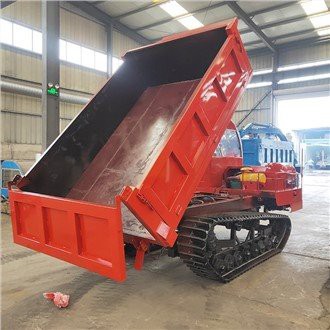
Small Tracked Vehicle
product description
Crawler transport vehicle is a kind of special transport vehicle with track as a walking device, which shows unique transport capability under various complex working conditions. It is mainly composed of engine, transmission system, walking system, bearing body and control system and other core parts.
As a power source, the engine provides strong power for the vehicle operation. The transmission system is responsible for transferring the power of the engine to the walking system to ensure the efficient transmission of power. The track in the walking system is the key, which consists of multiple track plates connected by track pins and encircle the drive wheel, guide wheel and support wheel. When the engine starts, the power is transmitted to the drive wheel through the transmission system, and the drive wheel turns to drive the track cycle movement, using the friction between the track and the ground to push the vehicle forward or backward.
Compared with wheeled transporters, tracked transporters have significant advantages. Its ground area is large, the ground pressure is small, can be in mud, sand, snow, mountains and other complex terrain unimpeded, such as in the swamp, wheeled vehicles are easy to deep, and tracked transport vehicles can pass smoothly. Strong traction is also its highlight, can easily pull heavy cargo, in climbing and other scenarios, can be stable transport, not easy to slip. In addition, the stability of the tracked transporter is excellent, and it can also maintain balance when driving on rough roads or slopes, reducing the risk of rollover.
In the field of application, crawler transporters are widely used. In the field of agriculture, it can transport agricultural materials and agricultural products in the field to help agricultural production; In forestry, shuttling through the mountains and forests to transport timber, to solve the transportation problems of complex terrain; Project construction scenario, undertake the heavy responsibility of transporting building materials and construction equipment; In the military field, it is also an important material transport equipment to adapt to the harsh battlefield environment and ensure the supply of materials for military operations.

Best after-sale
Our after-sales service team is always ready to serve you to ensure that there are no problems during your use
State of the art technology
Our technical team will use the highest enthusiasm to manufacture the equipment you need
the best service
Our sales team will provide you with warm and professional service to make your career more prosperous
Jining Flying Rain Mechanical & Electrical Technology Co., Ltd. specializes in producing advanced machinery, including prestressed slab, purlin, lintel & wood forming machines, light wallboard equipment, cranes (truck-mounted & crawler types), sweepers, etc. Our designs are scientific, durable, and user-friendly, ensuring fast, high-quality production with cost savings and long service life, enhancing clients' competitiveness and profitability.
We prioritize quality, service, and customer satisfaction. Rapid parts delivery, 24/7 customer support, and lifelong maintenance ensure seamless operations. Our "customer-centric" approach offers comprehensive services, with "service as the core" to deliver maximum value. Quality focus and all-round customer care are our hallmarks. High-quality products, impeccable services, and competitive pricing are our principles. We strive for excellence in every aspect, partnering with clients for mutual success based on integrity, quality, and service.
You may be interested
We recommend the following equipment that you may be interested in
mini-excavator
Small excavators have become the ideal choice for urban construction and complex construction environments with their advantages of strong flexibility, wide operating range, convenient transfer and high cost effectiveness.


Mine transport vehicle
Due to its strong load capacity, robustness to adapt to harsh working conditions and high transportation efficiency, the mining truck has become an indispensable important equipment in mining.
Crawler transporter
Tracked transporters offer unparalleled transport advantages in difficult terrain and harsh environments thanks to their excellent ground mobility, strong traction and stability.


hydraulic aerial cage
With its excellent lifting capacity, stable working platform and wide range of work, the aerial work vehicle provides a safe, efficient and flexible solution for aerial work.
electric forklift
With its advantages of zero emission, low noise, easy operation and high energy efficiency, electric forklifts have become the preferred equipment for green handling in the field of modern warehousing and logistics.


Diesel three-wheeled transporter
With its powerful loading capacity, flexible driving performance and the long-lasting power provided by diesel engines, diesel three-wheeled transporters are highly efficient tools in short-haul and heavy-duty operations.
precautions for product use
Please pay attention to the following precautions in use
Pre-operation training and qualification confirmation: the operator must be professionally trained, familiar with the operation process, performance characteristics and safety precautions of the crawler transport vehicle, and hold the corresponding operation qualification certificate. It is strictly forbidden for untrained personnel to operate the vehicle without authorization to avoid safety accidents and equipment damage caused by improper operation.
Uniform load distribution: When loading the goods, ensure that the goods are evenly distributed in the carriage to avoid the phenomenon of bias. Excessive weight will cause the center of gravity of the vehicle to shift, affect the driving stability, in turning, climbing or through the uneven road surface, easy to rollover accidents. For goods with irregular shapes or a high center of gravity, reinforcement measures must be taken to prevent the goods from moving during transportation.
Severe weather response: In severe weather such as heavy rain, strong wind and fog, crawler transporters should be used with caution. Heavy rain may lead to slippery roads and water, increasing the risk of vehicle skidding and loss of control; High winds may affect the direction of the vehicle, especially when transporting large and light goods; Heavy fog can reduce visibility and affect drivers' line of sight. If you must work in bad weather, reduce your speed, turn on your warning lights, and stay alert.
Regular inspection of wearing parts: Regularly check the wear and tear of tracks, tires (if any), brake pads, filters and other wearing parts. The wear of the track directly affects the driving performance and safety of the vehicle. If the track plate is found to be seriously worn and the track pin is loose, it should be replaced or repaired in time. Uneven tire wear or insufficient air pressure will affect the driving stability; Excessive wear of brake pads will reduce braking effect; Clogged filters can affect engine performance. In accordance with the provisions of the vehicle manual, regularly replace the wearing parts to ensure that the vehicle is always in good running condition.
Avoid long idling: Long idling will make the engine burn inadequately, produce carbon deposits, reduce engine performance, and increase fuel consumption and environmental pollution. When waiting for work or temporary parking, if the parking time is long, the engine should be turned off, and when it needs to start again, follow the normal starting process.
Emergency handling training: Operators should receive emergency handling training, familiar with the vehicle in the event of failure, fire, collision and other emergency response measures. For example, when the vehicle fire, should immediately stop, turn off the engine, use the fire extinguisher, and timely alarm; When the vehicle fails to drive, the vehicle should be moved to a safe area, set up warning signs, and contact maintenance personnel for maintenance.
You may want to ask
Jining Feiyu electromechanical technology Co., LTD
Crawler transporter found abnormal engine sound after starting, what may be the cause?
Abnormal engine sound is a more complex problem, behind which there may be many reasons. As the core power source of the vehicle, the engine has a precise internal structure and many parts work together. When the internal parts of the engine wear, it is easy to cause abnormal sound. Taking the piston and cylinder wall as an example, under long-term high-speed operation and high temperature environment, the fit clearance between the piston and cylinder wall may gradually increase. When the clearance is beyond the normal range, the piston will have an irregular impact when it moves in the cylinder, thus issuing a knocking sound. This sound is usually a crisp and rhythmic metal tapping sound, which may be more obvious when the engine starts cold, and the sound may change as the engine temperature rises, but if it is not handled in time, it will gradually increase the wear of the engine, and may even lead to serious failures such as piston jam and cylinder wall strain.
Excessive valve clearance is also one of the common causes of abnormal engine sound. The valve is responsible for controlling the timing of intake and exhaust during the operation of the engine. When the valve clearance is too large, the valve will produce a large impact force between the valve seat or the valve tappet during the opening and closing process, resulting in a rattling sound. This sound is generally more crisp, and changes with the engine speed, the higher the speed, the faster the frequency of the rattle. Excessive valve clearance will not only produce noise, but also affect the intake and exhaust efficiency of the engine, resulting in reduced engine power and poor fuel economy.
In addition, the engine belt plays an important connecting role in the entire power transmission system. If the belt is loose or worn, it will slide relative to the pulley during operation, resulting in a squeaking sound. Loosening of the belt may be due to the failure of the tensioning device due to prolonged use, or the improper adjustment of the tensioning during installation. The wear of the belt may be due to long-term stretching, friction, and contact with harmful substances such as oil and water. Once the engine is found to have abnormal sound, the driver should immediately stop and check, through professional diagnostic tools and methods, accurately determine the cause of the fault, and timely maintenance, to avoid more serious damage caused by minor faults, resulting in high maintenance costs and operation delays.
When using crawler transporters for transportation operations, how to reasonably plan the route?
Reasonable transportation route planning is the key link to ensure that the crawler transporter can complete the transportation task efficiently and safely. When planning a route, the weight and volume of the goods to be transported must first be fully considered. The weight and volume of different goods vary greatly, which directly affects the driving performance and passing capacity of the vehicle. For overweight or ultra-wide, ultra-high cargo, the power demand of the vehicle will increase, and the driving stability will also be affected. Therefore, according to the actual situation of the goods, choose the road that can carry the total weight of vehicles and goods, and ensure that the width and height of the road meet the requirements of the transportation of goods.
Road condition is an important factor in route planning. Try to choose a flat and solid road, which can reduce the turbulence and vibration of the vehicle, reduce the risk of damage to the cargo, but also reduce the wear of vehicle parts, and extend the service life of the vehicle. To avoid the steep slope of the road, because in the climbing process, the vehicle needs to consume more power, for heavy vehicles, there may be a lack of power, stalling or even slipping danger; When going downhill, the steep slope will make the speed of the vehicle difficult to control, increase the burden of the brake system, and easily lead to brake failure. Complex road sections, such as narrow streets, curved and urgent mountain roads, bumpy dirt roads, etc., should also be avoided as far as possible, these sections will not only affect the speed of the vehicle, but also may occur due to the inconvenience of vehicle operation scraping, collision and other accidents.
If you are transporting large goods, you need to pay special attention to the road height and width limits. In urban roads and some specific areas, height-limiting poles and width-limiting piers are set up to ensure the safety and smooth flow of roads. When planning your route, learn about these restrictions in advance by consulting maps, consulting local traffic authorities, or using professional navigation software. For ultra-high and ultra-wide goods, it may be necessary to choose some special routes or apply for temporary passage permits to ensure that the goods can pass smoothly.
In addition, it is essential to know the traffic conditions along the way. Traffic congestion can seriously affect transportation efficiency, increase transportation time and cost. Through real-time traffic information platforms, traffic broadcasting and other channels, you can understand the traffic flow and congestion of the road in advance, and avoid traffic congestion periods and areas. For example, in the morning and evening peak hours, the main road in the city often has a large traffic flow and is prone to congestion, at this time, you can choose some small traffic flow or avoid the city center area. When planning the route, you can also consider reserving a certain amount of time to cope with possible emergencies, such as traffic accidents, road construction, etc., to ensure that the goods can be delivered to the destination on time.
How to maintain the hydraulic system of crawler transporter?
The hydraulic system of crawler transporter is one of the key systems to ensure the normal operation of the vehicle, and its maintenance is very important. Regular inspection of the oil level and quality of hydraulic oil is the basic work to maintain the hydraulic system. Hydraulic oil plays an important role in the transmission of power, lubrication and cooling in the hydraulic system. The hydraulic oil level is too low, which will cause the hydraulic pump to absorb oil difficult, the system pressure is unstable, and even the hydraulic pump may be damaged due to lack of oil. Therefore, in accordance with the requirements of the vehicle manual, the hydraulic oil level should be regularly checked, which can generally be observed by the oil level meter on the hydraulic tank. When the oil level is lower than the lowest scale line, the hydraulic oil that meets the specifications should be added in time.
The quality of hydraulic oil can not be ignored. With the increase of the use time and the influence of the working environment, the hydraulic oil will gradually oxidize and pollute, and its performance will also decline. Deteriorating hydraulic oil will not only reduce the efficiency of the system, but also may cause corrosion and wear to the hydraulic components. When checking the quality of hydraulic oil, it can be preliminarily judged by observing the color, transparency and odor of the oil. Normal hydraulic oil should be clear and transparent, slightly yellow, no obvious odor. If the oil color turns black, becomes cloudy, and has a pungent smell, it indicates that the hydraulic oil has deteriorated and needs to be replaced in time. In order to ensure the quality of hydraulic oil, it is also possible to regularly sample the oil, analyze the pollutant content, moisture content, pH and other indicators in the oil through professional testing equipment, and decide whether the hydraulic oil needs to be replaced according to the test results.
Checking whether there is leakage and aging of hydraulic pipelines is also an important part of maintaining hydraulic systems. The hydraulic pipeline is responsible for transporting hydraulic oil to each hydraulic component. Once leakage occurs, the system pressure will drop, affecting the normal operation of the vehicle. Leakage of hydraulic oil may also pollute the environment and cause safety hazards. When checking the hydraulic pipeline, carefully check the connection of the pipeline, bending parts and places vulnerable to external force impact, whether there are traces of oil seepage. If a leak is found, the cause should be found and repaired in time. For leakage caused by aging and damage of seals, new seals need to be replaced; For leaks due to broken or worn lines, damaged lines may need to be replaced. In addition, it is necessary to check whether the hydraulic pipeline is aging and cracking, the strength of the aging pipeline is reduced, and it is easy to break under high pressure, so once the aging pipeline is found, it should be replaced in time.
Regular cleaning of the filter of the hydraulic system is a key measure to prevent impurities from entering the system. The role of the filter is to filter impurities, particles and pollutants in the hydraulic oil to ensure that the oil entering the hydraulic components is clean and pure. If the filter is blocked, the flow of hydraulic oil will be hindered, the system pressure will rise, resulting in an increase in the hydraulic pump load, but also affect the working accuracy and stability of the hydraulic components. In general, the filter needs to be cleaned or replaced regularly according to the use environment and work intensity of the vehicle. When cleaning the filter, special cleaning agents and tools should be used to operate in accordance with the correct method to ensure the filtration effect of the filter. At the same time, when replacing the filter, it is necessary to choose products that meet the specifications of the vehicle and avoid using inferior filters, so as not to affect the normal operation of the hydraulic system.
When the steering of the tracked transporter becomes insensitive, how to troubleshoot the problem?
When the steering of the tracked transport vehicle is not sensitive, it is necessary to conduct system investigation from multiple aspects to accurately find out the cause of the failure and solve it in time. The steering power system is the first thing to check. The role of the steering power system is to provide additional help when the driver turns the steering wheel, making steering easier and less effort. If the power assist system fails, the driver will obviously feel that the steering is difficult and the steering is not sensitive. First of all, check whether the booster oil is insufficient or deteriorated. Insufficient power oil will lead to the power system can not work properly, unable to provide enough power; The deterioration of the power oil will affect its lubrication and power transmission performance, which will also lead to a decline in the power effect. You can judge whether the power oil is normal by checking the oil level of the power tank and observing the color and transparency of the power oil. If the power oil is insufficient, the power oil that meets the specifications should be added in time; If the power oil deteriorates, it is necessary to discharge all the old oil, clean the power system, and add a new power oil.
Booster pump is also one of the core components of the steering power system, to check whether the booster pump is working properly. The booster pump is driven by the power of the engine, and the hydraulic oil is pressurized and transmitted to the steering system to provide power for the steering. If the booster pump fails, such as internal parts wear, seals damage, etc., it will lead to the booster pump can not output pressure normally, thus making the steering power failure. Professional hydraulic testing equipment can be used to test whether the output pressure of the booster pump meets the standard requirements. If the booster pump output pressure is too low, it is necessary to further check the internal structure of the booster pump, determine the cause of the failure and repair or replace it.
Second, check whether the steering tie rod and ball head are loose or worn. The steering rod and the ball head are important parts that connect the steering wheel and the wheels, and their role is to transfer the rotation of the steering wheel to the wheels to realize the steering of the vehicle. If the steering tie rod and ball head are loose, there will be a gap in the steering connection part, so that the rotation of the steering wheel can not be accurately transmitted to the wheel, thus affecting the accuracy of steering; The worn steering rod and ball head will reduce the accuracy of the steering system, and also lead to insensitive steering. In the inspection, you can manually shake the steering rod and the ball head to feel whether there are signs of loosening, and observe whether the surface of the ball head and the rod is worn, deformed, etc. If the steering tie rod or ball head is found to be loose or worn, it should be tightened or replaced in time.
Also, check tire pressure and track tension. For tracked transporters equipped with tires, insufficient tire pressure will increase the contact area between the tires and the ground, increase friction, resulting in increased steering resistance and insensitive steering. Therefore, it is necessary to regularly check the tire pressure and adjust the tire pressure to the appropriate value according to the requirements of the vehicle user manual. For crawler transporters, track tension also has an important impact on steering performance. If the track is too loose, it will make the track jump and slip in the process of running, which will affect the driving stability and steering accuracy of the vehicle. The track is too tight will increase the friction between the track and the drive wheel, the guide wheel, making the steering operation difficult. According to the vehicle instruction manual, the use of professional tools to check and adjust the track tension, to ensure that the track is in a proper state of tension. Through the above comprehensive and systematic investigation methods, we can quickly and accurately find out the reasons for the insensitive steering of the tracked transport vehicle, and take appropriate measures to repair it, so as to ensure the safe driving and normal operation of the vehicle.
Hot Tags: small tracked vehicle, China small tracked vehicle manufacturers, factory, Small Track Crawler Dumpers with Lifting Crane, Crawler Dump Truck 6-20 Ton, Small Tracked Dumper CrawlerMini Dumper Truck, 30 ton articulated dump truck, belly dumper truck, 8ton Crawler Dumper
Previous
Garden Tracked DumperYou Might Also Like


Send Inquiry