






Crawler Dumper Transporter
product description
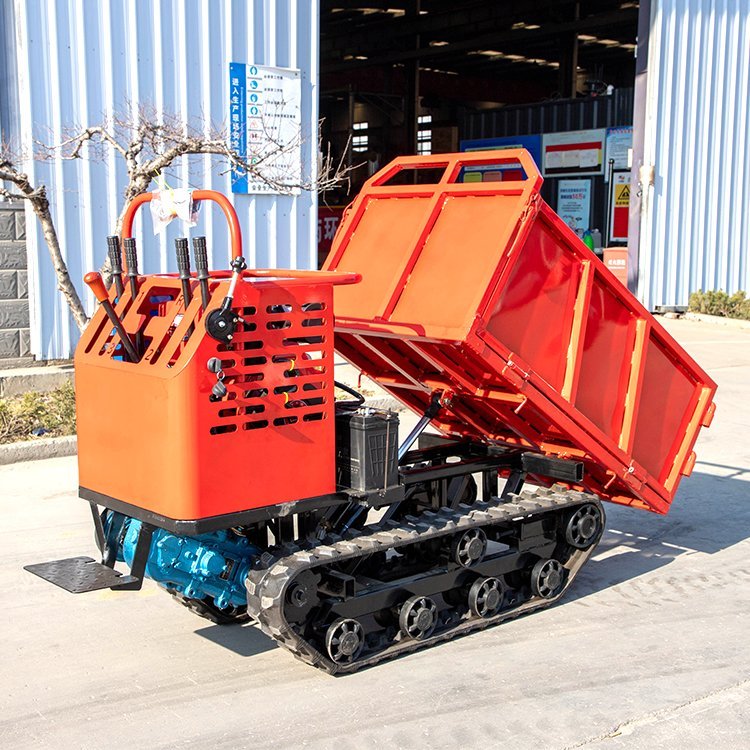
Crawler transporter is a kind of transport equipment with track as the walking device. The working principle is that the engine transmits power to the driving wheel, which drives the track to operate, and the friction between the track and the ground is used to achieve the forward or backward movement of the vehicle.
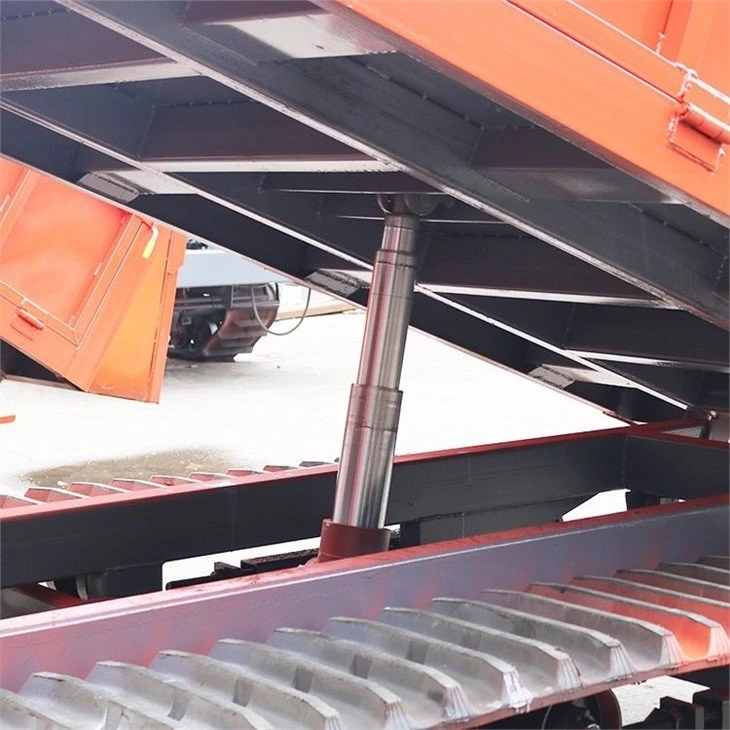
From the structural point of view, the tracked transporter is mainly composed of the engine, the transmission system, the walking system (including the track, the drive wheel, the guide wheel, etc.) and the carrying body. This structure gives it unique performance advantages: first, excellent off-road capability, the track and the ground contact area is large, the ground pressure is small, can easily pass through muddy, sandy, mountain and other complex terrain; The second is the strong traction force, which can adapt to the needs of heavy transportation, and can also work stably in scenarios such as climbing.
In the field of application, crawler transporters are widely used in agriculture to help farmers transport farm materials and agricultural products in the field; In forestry, timber can be transported in the mountains and forests; In the construction of the project, it bears the heavy responsibility of transporting building materials and construction equipment; In the military field, it is also a key equipment to ensure the transportation of materials and help the smooth development of military operations.

Best after-sale
Our after-sales service team is always ready to serve you to ensure that there are no problems during your use
State of the art technology
Our technical team will use the highest enthusiasm to manufacture the equipment you need
the best service
Our sales team will provide you with warm and professional service to make your career more prosperous
Jining Flying Rain Mechanical & Electrical Technology Co., Ltd. specializes in producing advanced machinery, including prestressed slab, purlin, lintel & wood forming machines, light wallboard equipment, cranes (truck-mounted & crawler types), sweepers, etc. Our designs are scientific, durable, and user-friendly, ensuring fast, high-quality production with cost savings and long service life, enhancing clients' competitiveness and profitability.
We prioritize quality, service, and customer satisfaction. Rapid parts delivery, 24/7 customer support, and lifelong maintenance ensure seamless operations. Our "customer-centric" approach offers comprehensive services, with "service as the core" to deliver maximum value. Quality focus and all-round customer care are our hallmarks. High-quality products, impeccable services, and competitive pricing are our principles. We strive for excellence in every aspect, partnering with clients for mutual success based on integrity, quality, and service.
You may be interested
We recommend the following equipment that you may be interested in
mini-excavator
Small excavators have become the ideal choice for urban construction and complex construction environments with their advantages of strong flexibility, wide operating range, convenient transfer and high cost effectiveness.


Mine transport vehicle
Due to its strong load capacity, robustness to adapt to harsh working conditions and high transportation efficiency, the mining truck has become an indispensable important equipment in mining.
Crawler transporter
Tracked transporters offer unparalleled transport advantages in difficult terrain and harsh environments thanks to their excellent ground mobility, strong traction and stability.


hydraulic aerial cage
With its excellent lifting capacity, stable working platform and wide range of work, the aerial work vehicle provides a safe, efficient and flexible solution for aerial work.
electric forklift
With its advantages of zero emission, low noise, easy operation and high energy efficiency, electric forklifts have become the preferred equipment for green handling in the field of modern warehousing and logistics.


Diesel three-wheeled transporter
With its powerful loading capacity, flexible driving performance and the long-lasting power provided by diesel engines, diesel three-wheeled transporters are highly efficient tools in short-haul and heavy-duty operations.
precautions for product use
Please pay attention to the following precautions in use
Comprehensive inspection of equipment and environment before starting: Before starting the crawler transport vehicle, be sure to carry out a thorough and detailed inspection. In addition to routine inspection items, it is necessary to pay special attention to the surrounding environment of the vehicle to ensure that no personnel are near or obstructed during the start process to avoid causing safety accidents. At the same time, carefully check the various instruments and indicators on the console to confirm that the display is normal, and the system self-test is not abnormal. Only when the vehicle starting conditions are fully met, the vehicle can be started.
Pay close attention to instrument data during operation: During the operation of the vehicle, the driver needs to always keep an eye on the key data such as oil temperature, water temperature and oil pressure on the dashboard. These data are like the "health indicators" of the vehicle, which can directly reflect the operating status of the equipment. Once it is found that the oil temperature is too high, the water temperature is abnormal, or the oil pressure is unstable, you should immediately choose a safe place to stop and check. Equipment overheating may be due to cooling system failure, insufficient lubrication or long-term high load operation and other reasons, if not handled in time, it is likely to cause serious failure, resulting in equipment damage and operation delay.
The operation action should be smooth and smooth: when operating the steering, forward, backward and other actions of the crawler transport vehicle, be sure to avoid the direction or the accelerator. Sudden operation will make the vehicle instantly bear a huge impact force, which will not only seriously affect the stability of the driving, increase the risk of vehicle loss of control, but also may cause irreversible damage to the transmission components such as the drive shaft, universal joint, transmission gear, etc., shorten the service life of the equipment and increase the maintenance cost.
Flexible driving according to different terrain: when driving in the snow, due to the small friction in the snow, the vehicle is easy to slip out of control. At this time, the speed should be properly reduced, driving slowly, increasing the friction between the vehicle and the snow, to ensure safety. When driving on the waterlogged road, it is necessary to carefully observe and judge the depth of the water in advance, avoid rashly entering the deep waterlogged area, and prevent the water from pouring back into the engine air intake, causing the engine to stall or even serious mechanical failure. If the depth of water can not be accurately determined, find other safe routes around.
Regular cleaning of the cooling system: During the working process of the tracked transport vehicle, the engine, gearbox and other key components will continue to generate a lot of heat. To ensure the normal operation of the device, you must regularly clean the dust, debris, and oil on the surface of the radiator. These deposits will seriously affect the heat dissipation effect of the radiator, resulting in overheating of the equipment, which will degrade the performance of the equipment, and even cause damage to parts. You are advised to clean and maintain the heat dissipation system regularly according to the requirements in the device user manual to ensure that the heat dissipation system is always in good working condition.
Properly park the vehicle after the operation: When completing the operation parking, the vehicle should be parked on a flat and solid ground, and the handbrake should be tightened to prevent the vehicle from sliding. If the vehicle needs to be parked for a long time, in order to reduce the long-term force of the track and avoid deformation or aging of the track due to long-term tightness, it is best to slightly relax the track. In addition, the vehicle should also be parked indoors or under shelter as far as possible to avoid direct sunlight and rain erosion, further extending the service life of the vehicle.
You may want to ask
Jining Feiyu electromechanical technology Co., LTD
Crawler transport vehicle in the driving suddenly appear track deviation, what is the cause of this?
The reason behind the track deviation phenomenon of crawler transporter in the process of driving is more complex, involving the state and interaction of several key components. Inconsistent track tensioning is a common and critical factor leading to deviation. The track consists of a series of track plates connected by track pins, and its tension is adjusted by a special tension device. When one side of the track is too tight and the other side is too loose, there will be a difference in the linear speed of the two sides of the track during travel. The tight side of the track travels a longer distance per unit time, and the vehicle will involuntarily turn to the tight side of the track, resulting in deviation. For example, in the process of long-term use, a certain side of the tensioning device may be loose due to vibration, wear and other reasons, so that the side track gradually becomes loose, resulting in deviation problems.
The guide wheel and the support wheel play an indispensable role in ensuring the normal running track of the track. The guide wheel is mainly responsible for guiding the direction of the track, while the support wheel is responsible for supporting the weight of the vehicle and making the track run smoothly. If there is a deviation in the installation position of the guide wheel or the support wheel, even if the Angle deviation is extremely small, the error will continue to accumulate during the operation of the track, and eventually lead to the track deviation. In addition, the degree of wear of the wheels is also an important factor. Due to the uneven force on each part of the vehicle in the process of driving, the wear speed of the guide wheel and the support wheel will also be different. The severely worn wheel will change the contact state between the track and the wheel, and then affect the running track of the track, resulting in deviation phenomenon.
Chassis component deformation, especially frame deformation, is easy to be ignored but will have a significant impact on track operation. As the overall support structure of the vehicle, the frame provides the installation base for the track, engine, transmission system and other components. When the frame is deformed due to external force impact, long-term overload use or manufacturing process defects, the installation plane of both sides of the track will no longer be parallel, resulting in uneven stress on both sides of the track during operation. This uneven force will force the track to the side with less force, which will cause the track to run off. For example, in some harsh construction environments, vehicles may accidentally collide with obstacles, resulting in local deformation of the frame, which in turn causes track deviation.
If the engine of the crawler transport vehicle suddenly fails when working in the field, how to deal with the emergency?
When working in the field, the engine of the tracked transport vehicle suddenly fails, which is a more difficult situation, but as long as you keep calm and follow the correct steps for investigation and treatment, you can often quickly solve the problem or provide accurate fault information for subsequent maintenance. When the engine suddenly shuts down, first of all, keep calm, must not panic. Take immediate measures to stop the vehicle in a safe and flat place, avoid parking on slopes, bends or other dangerous areas, and prevent the vehicle from slipping, rollover and other secondary accidents. At the same time, turn on the vehicle's hazard warning light to remind other operators and passing vehicles around to pay attention to safety.
After completing the safe stop, proceed to check the fuel system. Fuel is the power source of engine operation, and fuel exhaustion is one of the common reasons leading to engine stalling. Check the amount of fuel in the fuel tank. You can make a preliminary judgment by using the fuel gauge. If the fuel gauge is damaged or inaccurate, you can also check through the oil level observation hole of the fuel tank or use a special oil measurement tool. If insufficient fuel is found, the fuel that meets the requirements of the vehicle should be supplemented in time. When replenishing fuel in the field, pay attention to choosing the right fuel source, and ensure the safety of the refueling process to avoid dangers such as fire caused by fuel leakage.
If the fuel is sufficient, then focus on checking the spark plug of the engine. The spark plug is a key component of the engine ignition system, whose role is to generate an electric spark at the right time to ignite the combustible mixture in the engine cylinder. The spark plug works in high temperature and high pressure environment for a long time, which is prone to serious carbon accumulation and electrode damage. Carbon deposition will adhere to the electrode and insulator surface of the spark plug, which will affect the ignition energy and ignition stability of the spark plug. Damage to the electrodes may result in an inability to generate sparks normally. You can remove the spark plug and observe its appearance. If you find thick black carbon deposits on the electrode, you can use a special spark plug cleaning agent or sandpaper to clean up; If the electrode is seriously worn, broken, etc., a new spark plug should be replaced in time.
In addition to the spark plug, the engine's air filter can not be ignored. The role of the air filter is to filter the air entering the engine, prevent dust, impurities, etc., from entering the cylinder, and ensure the cleaning and normal combustion of the engine. In the field working environment, there are more dust and particles in the air, and the air filter is more easily blocked. When the air filter is blocked, the amount of air entering the engine is insufficient, which will cause the combustible mixture to be too strong, the combustion is insufficient, and eventually cause the engine to stall. The filter element of the air filter can be removed to check its blockage. If there is a large amount of dust and debris on the surface of the filter, compressed air can be used to blow outward from the inside of the filter to clean up the dust and debris; If the filter element has been seriously damaged or cannot be effectively cleaned, a new filter element should be replaced in time.
If after the above inspection and treatment, the engine still can not start normally, then it is likely that there is a mechanical failure inside the engine. The interior of the engine is a complex mechanical system, including pistons, connecting rods, crankshafts, valves and many other precision components. These parts in the long-term operation process, may be due to wear, fatigue, poor lubrication and other reasons for failure, such as piston ring fracture, crankshaft lock, valve seal is not tight. These mechanical failures often require professional maintenance personnel to use professional tools and equipment for maintenance and diagnosis. At this time, professional maintenance personnel should be contacted in time to describe in detail the specific situation before and after the engine flameout, such as whether there is abnormal sound, vibration, and the working state before flameout, so that maintenance personnel can quickly and accurately determine the cause of the fault and carry out maintenance.
How to carry out daily maintenance on the tracks of crawler transporters?
As a key walking part of the tracked transport vehicle, its daily maintenance is very important to ensure the normal operation and prolong the service life of the vehicle. Regular inspection of track tension is the first task of daily maintenance. The tension of track directly affects the driving performance of the vehicle and the service life of track. If the track is too tight, it will increase the friction between the track and the drive wheel, the guide wheel, and the support wheel, resulting in increased wear of these components, and it will also increase the load of the engine and reduce fuel economy. If the track is too loose, it is easy to have problems such as track falling off and jumping during driving, affecting the normal running of the vehicle. In general, the vehicle manufacturer will clearly specify the tensioning standard and inspection method of the track in the vehicle's instruction manual. A special track tension measuring tool can be used to measure in accordance with standard requirements. When it is found that the track tension does not meet the requirements, the tension of the track is adjusted by adjusting the tension device. The tensioning device usually has different types such as screw type and hydraulic type, and the operation should be carried out in accordance with the corresponding operating procedures to ensure the accuracy and safety of the adjustment.
Timely cleaning of dirt, sand and other debris on the surface of the track is also an important part of daily maintenance. In the process of vehicle driving, the track will be in close contact with the ground, and inevitably will be stained with a lot of dirt, sand and other debris. If these sundries are not cleaned up in time, they will enter the inside of the track with the rotation of the track, sandwiched between the track plate and the wheel, and aggravate the wear of the track and the wheel. In particular, sharp particles such as sand and stone will continuously scratch the surface of the track and wheel like sandpaper during the operation of the track, resulting in scratches and wear on the surface and reducing its service life. After each operation, the track can be cleaned with tools such as high-pressure water guns and brushes. When cleaning, pay attention to thoroughly clean the debris inside and outside the track, and avoid the direct impact of water on the electrical parts and sensitive parts of the vehicle.
In order to reduce the friction of the track connection parts and extend the service life of the track, every once in a while, the connection parts of the track, such as the track pin and chain joint, need to apply an appropriate amount of lubricating oil. The lubricating oil forms a protective film between these components, reducing friction and wear during their relative motion. When selecting lubricating oil, choose the appropriate model and specification according to the use environment and working conditions of the vehicle. In general, lubricants with good high temperature resistance, wear resistance and oxidation resistance should be selected. When applying lubricating oil, ensure that the lubricating oil is evenly covered on the surface of the connection part, you can use a brush, oil gun and other tools to apply. At the same time, pay attention to regularly check the margin and quality of lubricating oil, and timely supplement and replace lubricating oil.
When transporting heavy objects, how to ensure the safety of the crawler transporter?
When using crawler transporters to transport heavy objects, it is very important to ensure driving safety, which needs to be strictly controlled from many aspects. Before transporting heavy objects, be sure to carefully confirm whether the load of the vehicle is within the rated range. Each crawler carrier has its specific rated load, which is a safe bearing range determined by the design structure, dynamic performance, chassis strength and other factors of the vehicle. It is strictly prohibited to overload transportation, because overload will make the vehicle's power system, transmission system, walking system, etc., bear too much pressure, increase the risk of vehicle failure, and also seriously affect the vehicle's driving stability and handling. For example, overloading may lead to serious problems such as overheating of the engine, damage of transmission components, and breakage of the track, which can easily lead to safety accidents during driving. You can determine the rated load by looking at the operating instructions of the vehicle or the load label on the vehicle, and use professional weighing equipment to accurately weigh the weight to ensure that the weight of the transport is within the rated range.
The loading process can not be ignored. Placing heavy objects evenly in the carriage is the key to ensure the safety of the vehicle. If the weight is not evenly placed, it will cause the center of gravity of the vehicle to shift, making the vehicle lose balance during driving. In the case of turning, climbing, downhill, etc., the vehicle with the center of gravity shift is more prone to rollover accidents. When loading, it is necessary to rationally plan the placement position according to the shape, size and weight distribution of the weight, so that the center of gravity of the weight overlaps with the center of the carriage as far as possible. For some irregularly shaped heavy objects, fixed devices such as ropes and chains can be used to firmly fix them in the carriage to prevent movement due to the turbulence and vibration of the vehicle during driving.
Drive carefully at all times while driving. Reducing the speed is one of the important measures to ensure safety. The increase of heavy objects will increase the inertia of the vehicle and the braking distance will be longer, so the speed needs to be reduced in order to have enough time and distance to brake in the event of an emergency. At the same time, it is necessary to maintain smooth driving and avoid drastic operations such as sudden braking and sharp turns. Sudden braking will cause the weight to rush forward due to inertia, which may cause the weight to collide with the carriage, or even out of the carriage; Sharp turns will shift the center of gravity of the vehicle, increasing the risk of rollover. During the driving process, it is necessary to observe the road conditions in advance, reasonably control the speed and steering, and maintain the smooth running of the vehicle.
In addition, planning the driving route in advance is also an important part of ensuring transportation safety. Avoid complex road conditions and steep sections. Complex road sections, such as narrow roads, potholes and uneven road surfaces, sections with obstacles, etc., will increase the difficulty and risk of vehicle driving, and easily lead to collisions between vehicles and obstacles or into trouble. Sections with higher gradients, especially in the case of heavy loads, will put higher requirements on the vehicle's power system and braking system. When going uphill, if the vehicle power is insufficient, there may be a situation such as stalling and slipping; When going downhill, if the braking system fails, the vehicle may accelerate out of control, causing a serious safety accident. Therefore, before transporting heavy objects, it is necessary to carry out a detailed investigation and planning of the driving route, and choose a route with good road condition and small slope to ensure the safety of the transportation process.
Hot Tags: crawler dumper transporter, China crawler dumper transporter manufacturers, factory, 6 tonne dumper truck, 30 tonne dump truck, 30 ton articulated dump truck, Small Tracked Dumper CrawlerMini Dumper Truck, 25 ton dump truck, dump truck 8x4
You Might Also Like


Send Inquiry