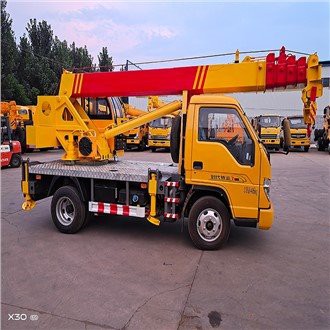
Control precision is a critical factor in the performance of rough terrain cranes, directly influencing their efficiency, safety, and the quality of work they can accomplish. As a supplier of rough terrain cranes, understanding the nuances of control precision is essential for providing our customers with the best equipment and technical support.
Understanding Control Precision
Control precision in a rough terrain crane refers to the ability of the operator to accurately manipulate the crane's movements, including lifting, lowering, slewing, and telescoping. It is measured by how closely the actual movement of the crane matches the operator's intended movement. High control precision means that the crane can perform tasks with minimal error, allowing for more accurate positioning of heavy loads and smoother operation.
Several factors contribute to the control precision of a rough terrain crane. First and foremost is the design and quality of the control system. Modern cranes are equipped with advanced hydraulic or electronic control systems that transmit signals with high accuracy. These systems use sensors to monitor the position, speed, and load of the crane at all times, providing real - time feedback to the operator.
The quality of the hydraulic components, such as pumps, valves, and cylinders, also plays a crucial role. High - grade hydraulic components can respond quickly and precisely to control signals, reducing the lag between the operator's input and the crane's movement. Additionally, the mechanical structure of the crane, including the boom, jib, and chassis, must be designed to minimize flexing and vibration, which can affect the accuracy of the crane's movement.
Importance of Control Precision
The importance of control precision in rough terrain cranes cannot be overstated. In construction sites, where space is often limited and the margin for error is small, high control precision allows for more efficient use of space. For example, when placing pre - fabricated building components, a crane with high control precision can position the components exactly where they need to be, reducing the need for re - positioning and speeding up the construction process.
Safety is another significant aspect. Precise control helps operators avoid collisions with other objects on the site, such as buildings, other cranes, or workers. When handling heavy loads, inaccurate control can lead to unstable loads, which may cause the crane to tip over. By having a high level of control precision, operators can maintain the stability of the load throughout the lifting process, ensuring the safety of everyone on the site.
Moreover, control precision affects the quality of the work. In industries such as bridge construction or industrial installation, where tolerances are extremely tight, a crane with precise control can help meet the required specifications. This results in higher - quality structures and fewer reworks, ultimately saving time and money.
Factors Affecting Control Precision
One of the primary external factors affecting control precision is the terrain. Rough terrain cranes are designed to operate on uneven and challenging surfaces. However, the condition of the ground can still impact the crane's stability and, consequently, its control precision. Soft, muddy, or sloping ground can cause the crane to shift or tilt, making it more difficult to control the crane's movements accurately.
Weather conditions also play a role. Strong winds, rain, or extreme temperatures can affect the crane's mechanical and hydraulic components. For example, high winds can exert additional forces on the load and the boom, making it more challenging to maintain control. Cold temperatures can thicken the hydraulic fluid, reducing the responsiveness of the hydraulic system.


The operator's skill and experience are equally important. Even the most advanced crane with high - end control systems requires a competent operator to fully utilize its control precision. An experienced operator can anticipate the crane's movements, make the necessary adjustments in a timely manner, and handle unexpected situations effectively.
Improving Control Precision
To improve the control precision of our rough terrain cranes, we invest heavily in research and development. We are constantly exploring new technologies and materials to enhance the performance of our cranes. For instance, we are incorporating more advanced sensors into our control systems. These sensors can detect even the slightest changes in the crane's position, speed, and load, allowing for more precise control.
In addition to sensor technology, we are also working on improving the software algorithms of our control systems. These algorithms can analyze the data from the sensors in real - time and adjust the control signals accordingly. This ensures that the crane's movements are as accurate as possible, regardless of the operating conditions.
We also provide comprehensive training programs for our customers' operators. These training programs cover both theoretical knowledge and practical skills. Through hands - on training, operators can become more familiar with the crane's control system, learn how to handle different situations, and improve their control precision.
Comparison with Other Types of Cranes
When compared to other types of cranes, such as Small Telescopic Crawler Crane, 10 Tons Truck Crane, and Spider Crane, rough terrain cranes have their unique advantages in terms of control precision.
Small telescopic crawler cranes are generally more suitable for small - scale projects. While they may have good mobility on soft ground, their control precision may be limited due to their relatively smaller size and simpler control systems. 10 - tons truck cranes are designed for general - purpose lifting on flat roads. However, their control accuracy may be affected by the vehicle's movement on uneven terrain. Spider cranes are known for their compact size and ability to work in tight spaces. But they may not offer the same level of control precision as rough terrain cranes when it comes to handling heavy loads and performing complex operations.
Rough terrain cranes, on the other hand, are specifically designed to operate on rough and uneven terrains while maintaining high control precision. Their robust design, advanced control systems, and large - capacity lifting capabilities make them the ideal choice for a wide range of construction and industrial projects.
Conclusion
In conclusion, control precision is a vital characteristic of rough terrain cranes. It is determined by a combination of factors, including the control system design, hydraulic components, mechanical structure, and external operating conditions. As a rough terrain crane supplier, we are committed to providing our customers with cranes that offer the highest level of control precision.
By continuously investing in research and development, improving our manufacturing processes, and providing excellent operator training, we aim to meet the evolving needs of our customers. Whether you are working on a large - scale construction project or a specialized industrial installation, our rough terrain cranes can provide you with the precise control you need to get the job done safely and efficiently.
If you are interested in purchasing our rough terrain cranes or would like to discuss your specific requirements further, please do not hesitate to contact us for a procurement negotiation. We look forward to partnering with you to achieve your project goals.
References
- "Crane Operations Handbook" by Charles S. Brooks
- "Engineering Mechanics: Statics and Dynamics" by Russell C. Hibbeler
- Industry reports on construction equipment technology advancements