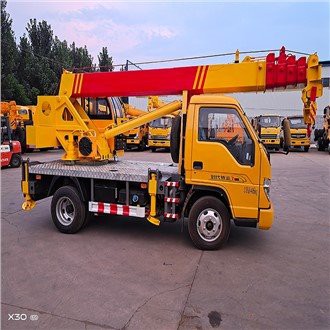
Hey there! I'm in the business of supplying Mini Lift Crane Trucks, and I often get asked how the maneuverability of these little powerhouses stacks up against larger cranes. Well, let's dive right in and explore this topic.
The Basics of Maneuverability
First off, what do we mean by maneuverability? In the context of cranes, it's all about how easily a crane can move around a job site, position itself for a lift, and navigate tight spaces. It includes things like turning radius, the ability to make sharp turns, and how quickly it can get from one point to another.
Mini Lift Crane Trucks: The Agile Champions
Mini Lift Crane Trucks are like the sports cars of the crane world. They're designed to be nimble and quick on their feet. One of the biggest advantages they have is their small size. With a shorter wheelbase and a smaller overall footprint, they can easily navigate through narrow alleys, crowded construction sites, and areas with limited access.
For example, imagine you're working on a renovation project in an old city center. The streets are narrow, and there are lots of obstacles like parked cars and pedestrians. A Mini Lift Crane Truck can easily squeeze through these tight spaces and get to the exact spot where the lift needs to be done. It can make sharp turns and reverse with ease, which is a huge plus when you're working in confined areas.
Another great thing about Mini Lift Crane Trucks is their speed. They can move around the job site much faster than larger cranes. This means less time spent on positioning and more time spent on actually doing the work. They're also easier to set up and take down, which further reduces the overall time required for a project.
Larger Cranes: The Powerhouses with Limitations
On the other hand, larger cranes are like the big trucks of the crane world. They're built for heavy lifting and can handle much larger loads than Mini Lift Crane Trucks. However, their size and weight come with some limitations when it comes to maneuverability.
Larger cranes typically have a much larger turning radius. This means they need more space to make a turn, and they may not be able to access certain areas that are too tight. For instance, if you're working on a construction site with a lot of buildings and equipment in the way, a large crane may struggle to get into the right position.
They also take longer to set up and take down. The process of deploying the outriggers, extending the boom, and ensuring the crane is stable can be time-consuming. This can add a significant amount of time to a project, especially if you need to move the crane multiple times.
Real-World Applications
Let's look at some real-world applications to see how the maneuverability of Mini Lift Crane Trucks and larger cranes plays out.
In a warehouse setting, Mini Lift Crane Trucks are a great choice. They can easily move through the aisles, pick up and move pallets, and position equipment with precision. Their small size allows them to work in areas where larger cranes would simply not fit. They can also be quickly repositioned as needed, which is important in a dynamic warehouse environment.
On a large-scale construction site, larger cranes may be necessary for the initial stages of building. They can lift heavy materials like steel beams and concrete blocks to great heights. However, once the building starts to take shape and the workspace becomes more confined, Mini Lift Crane Trucks can come in handy. They can be used for tasks like installing windows, moving small equipment, and performing maintenance work.
Cost-Effectiveness and Efficiency
Maneuverability also has an impact on cost-effectiveness and efficiency. Mini Lift Crane Trucks are generally more affordable to purchase and operate than larger cranes. They require less fuel, fewer maintenance costs, and can be operated by a single person in many cases. Their ability to quickly move around the job site and complete tasks means that you can get more work done in less time, which translates to cost savings.
Larger cranes, while more expensive, are necessary for certain heavy-lifting jobs. However, if you can use a Mini Lift Crane Truck for some of the tasks on a project, you can reduce your overall crane rental or ownership costs.
The Importance of Choosing the Right Crane
Choosing the right crane for the job is crucial. It's not just about the lifting capacity; maneuverability also plays a major role. By understanding the strengths and limitations of Mini Lift Crane Trucks and larger cranes, you can make an informed decision that will save you time, money, and headaches.
If you're in a situation where you need to work in tight spaces, a Mini Lift Crane Truck is the way to go. It will allow you to get the job done quickly and efficiently. On the other hand, if you're dealing with heavy loads and have plenty of space, a larger crane may be more appropriate.
Conclusion and Call to Action
So, there you have it! The maneuverability of Mini Lift Crane Trucks offers a unique advantage over larger cranes in many situations. Whether you're working in a cramped urban area, a warehouse, or a construction site with limited access, a Mini Lift Crane Truck can be a game-changer.
If you're interested in learning more about our Mini Lift Crane Trucks or need some advice on choosing the right crane for your project, don't hesitate to get in touch. We're here to help you make the best decision for your business. And if you ever need to explore other crane options, check out our Tractor Flatbed Crane, Hydraulic Mobile Crane, or 25 Ton Truck Crane. Let's start a conversation and see how we can meet your crane needs!


References
- Various industry reports on crane performance and applications.
- Personal experience and observations from working with different types of cranes on job sites.