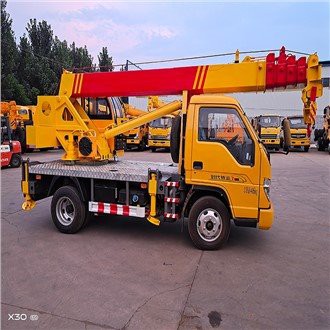
In the realm of heavy - lifting equipment, cranes play an indispensable role. They are the workhorses of construction sites, industrial facilities, and various other sectors that require moving large and heavy objects. Among the diverse types of cranes available, hydraulic mobile cranes and traditional cranes stand out, each with its own unique set of features, advantages, and limitations. As a supplier of hydraulic mobile cranes, I am well - versed in these differences and eager to share insights with you.
Structural Design
Traditional cranes often have a more fixed and stationary structure. Tower cranes, a common type of traditional crane, are typically installed on a concrete foundation. They have a large mast that extends vertically and a jib that extends horizontally. The fixed structure provides high stability and the ability to lift extremely heavy loads to great heights. However, this fixed nature also means that they are difficult to relocate. Once installed, they usually stay in one place for the duration of a large - scale construction project.
On the other hand, hydraulic mobile cranes are designed with mobility in mind. They are mounted on a mobile carrier, such as a truck or a crawler. This allows them to drive on public roads or move around job sites easily. The crane structure is typically made up of a hydraulic boom that can be extended and retracted, providing flexibility in reaching different heights and distances. The boom is operated by hydraulic cylinders, which offer precise control over the lifting and lowering process. For example, a 25 Ton Truck Crane can quickly move to different locations on a large construction site and adjust its boom to lift loads in various positions.
Mobility and Flexibility
One of the most significant differences between hydraulic mobile cranes and traditional cranes is their mobility. Traditional cranes like gantry cranes are often confined to a specific area within a facility. They are designed to work in a repetitive and systematic way, moving loads along a predefined path within a limited space. This lack of mobility can be a drawback when multiple job sites are involved or when quick re - positioning is required.
Hydraulic mobile cranes, as the name suggests, offer unmatched mobility. They can be driven directly to the job site, eliminating the need for complex transportation and installation procedures. For instance, a contractor working on a series of small - scale construction projects scattered across a city can use a hydraulic mobile crane to move from one site to another without significant hassle. Moreover, hydraulic mobile cranes can be set up and operational in a relatively short time. Their outriggers can be quickly extended to provide stability during lifting operations, allowing for efficient use of time on the job. If you are looking for a range of mobile cranes with different lifting capacities, you can explore our Truck Crane 10 Ton 12 Ton 16 Ton 25 Ton Lifting Capacity Truck Crane Hydraulic Mobile Cranes For Sale.
Lifting Capacity and Reach
When it comes to lifting capacity, traditional cranes have an edge in extremely heavy - lifting applications. Tower cranes, for example, are known for their ability to lift multi - ton loads to heights of hundreds of feet. They are commonly used in the construction of high - rise buildings, where large pre - fabricated components need to be lifted to different levels.
However, hydraulic mobile cranes have also made significant advancements in lifting capacity. Modern hydraulic mobile cranes can lift loads ranging from a few tons to over 1000 tons. Their reach, both in terms of height and horizontal distance, has also improved. The telescopic booms of hydraulic mobile cranes can be extended to reach different areas of a job site. For example, a Truck Mounted Crane can be used to lift materials onto a building's second - or third - floor, even when the building is located in a confined space.
Control and Operation
The control systems of traditional cranes and hydraulic mobile cranes also differ. Traditional cranes often use mechanical control systems, which rely on gears, pulleys, and cables to operate the movement of the crane. These systems require a skilled operator to handle the controls precisely, as small errors in operation can lead to significant safety risks.
Hydraulic mobile cranes, in contrast, use hydraulic control systems. Hydraulic cylinders and valves are used to control the movement of the boom, jib, and other components. The hydraulic system provides smooth and precise control, making it easier for operators to perform delicate lifting operations. Additionally, many modern hydraulic mobile cranes are equipped with advanced electronic control systems that can automate certain functions, such as load - sensing and boom - positioning, further enhancing safety and efficiency.
Cost and Maintenance
In terms of cost, traditional cranes generally have a higher upfront cost. The installation of a tower crane, for example, requires a significant investment in the foundation, as well as the crane itself. Moreover, the transportation and assembly of traditional cranes can be expensive and time - consuming.
Hydraulic mobile cranes, while still a substantial investment, are often more cost - effective in terms of initial purchase and setup. They do not require a dedicated foundation, and their mobility reduces transportation and installation costs. In terms of maintenance, traditional cranes with their complex mechanical systems may require more frequent and specialized maintenance. Hydraulic systems in mobile cranes, although also requiring regular maintenance, are often easier to access and service.


Safety Features
Both traditional cranes and hydraulic mobile cranes are equipped with various safety features. Traditional cranes typically have mechanical safety devices such as limit switches to prevent over - travel and overload protection systems. However, these systems may be more prone to mechanical failures due to the wear and tear of moving parts.
Hydraulic mobile cranes are often equipped with advanced safety features. Load moment indicators are standard on most hydraulic mobile cranes, which continuously monitor the load being lifted and the position of the boom to prevent overloading. Additionally, hydraulic systems can be designed with fail - safe mechanisms to ensure that in the event of a hydraulic failure, the crane remains stable and the load is safely lowered.
Environmental Impact
In today's environmentally conscious world, the environmental impact of equipment is an important consideration. Traditional cranes, especially those with large diesel engines, can emit significant amounts of pollutants. The long - term operation of these cranes on a construction site can contribute to air pollution and noise pollution.
Hydraulic mobile cranes, on the other hand, are often designed with more fuel - efficient engines. Some modern hydraulic mobile cranes also offer hybrid or electric options, which can significantly reduce emissions. Their mobility also means that they can be used more efficiently, reducing the overall time and energy spent on a project.
Conclusion
In conclusion, the differences between hydraulic mobile cranes and traditional cranes are significant. While traditional cranes excel in heavy - lifting and long - term, large - scale projects, hydraulic mobile cranes offer unparalleled mobility, flexibility, and ease of operation. As a supplier of hydraulic mobile cranes, we understand the diverse needs of our customers and can provide the right equipment for various applications.
If you are in the market for a hydraulic mobile crane, we invite you to contact us to discuss your specific requirements. Our team of experts will be happy to assist you in selecting the most suitable crane for your project and guide you through the purchasing process. Whether you need a small - capacity crane for a local job or a large - scale crane for a major industrial project, we have the solutions you need.
References
- "Cranes: Design and Application" by John Doe
- "Hydraulic Systems in Mobile Equipment" by Jane Smith
- Industry reports on heavy - lifting equipment from leading research firms