



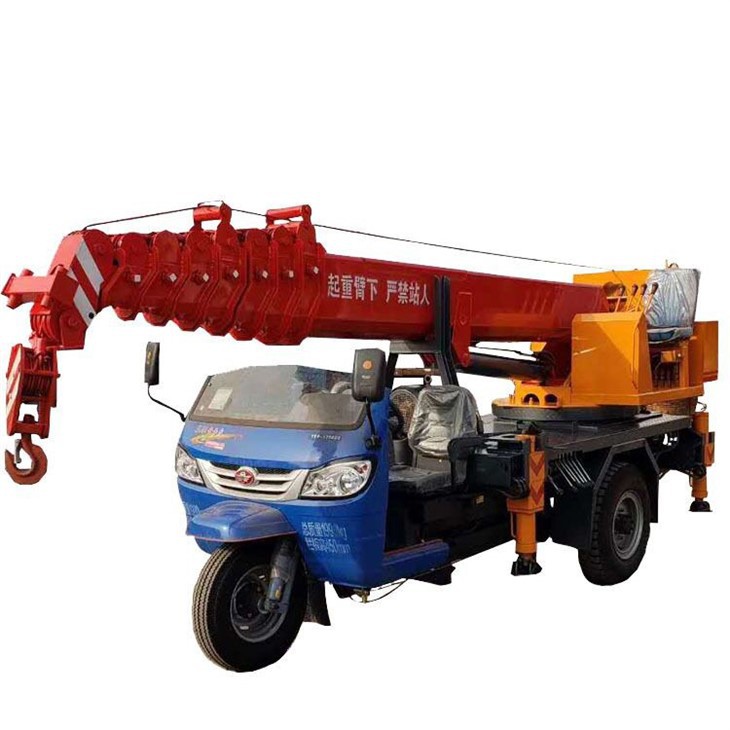
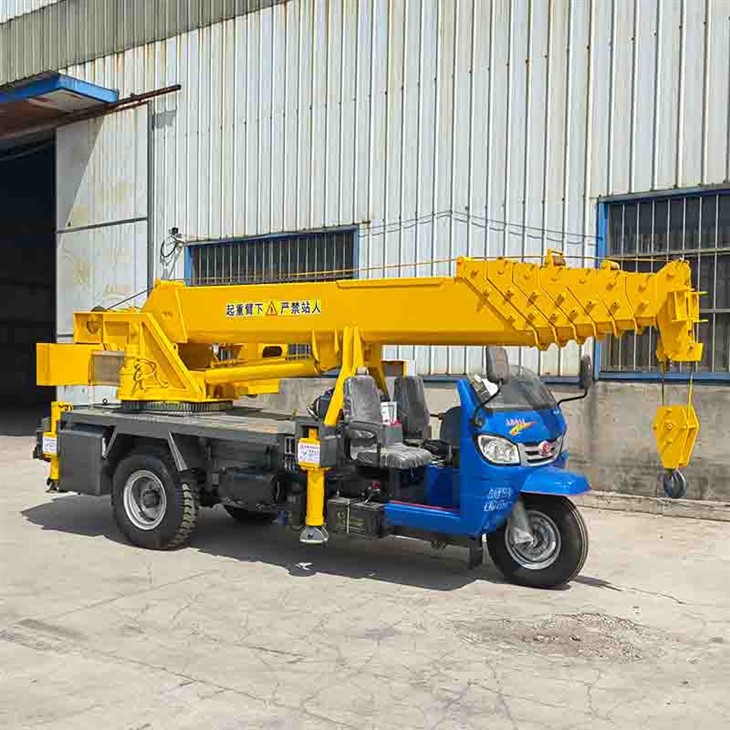
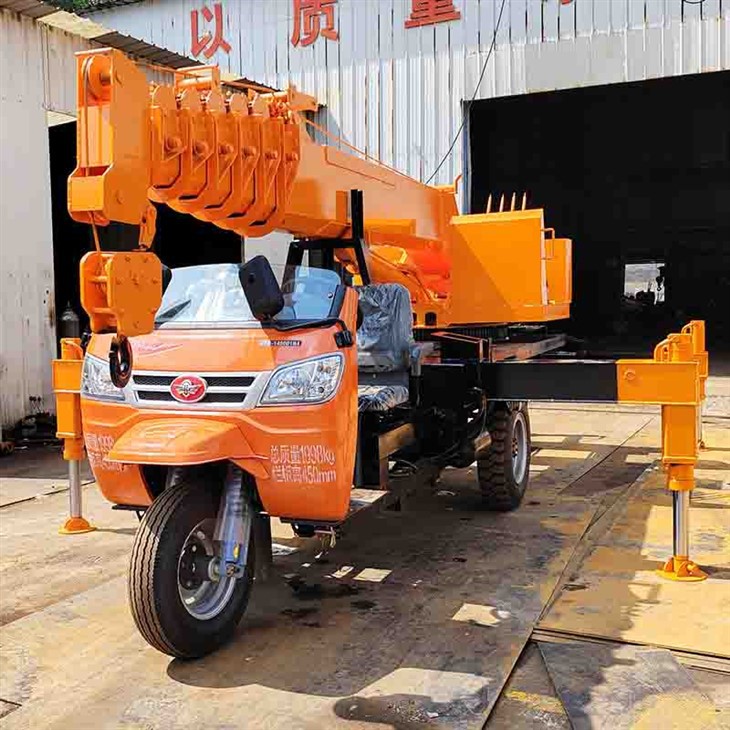

Three-wheeled Crane
The Three-Wheeled Crane: Solving the "Final 50 Meters" – An Engineer's Perspective
Every project has a bottleneck. For heavy lifting, it's often not the main crane lift, but the "final 50 meters"-the congested alley, the finished floor with a 3-ton load limit, the soft landscaping between the truck and the foundation. This is where conventional equipment fails, and manual labor becomes a safety and efficiency nightmare.
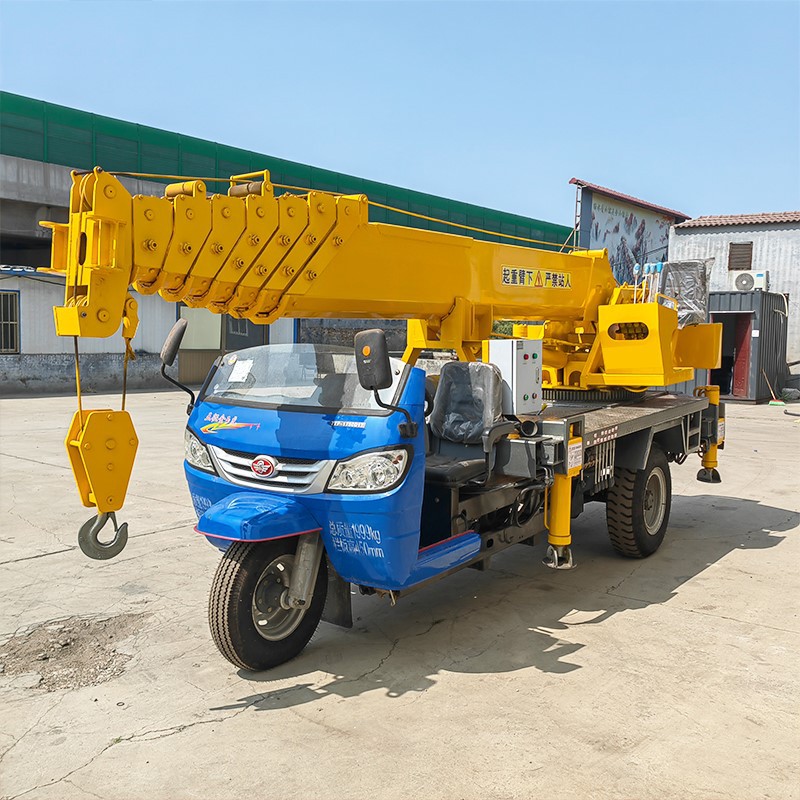
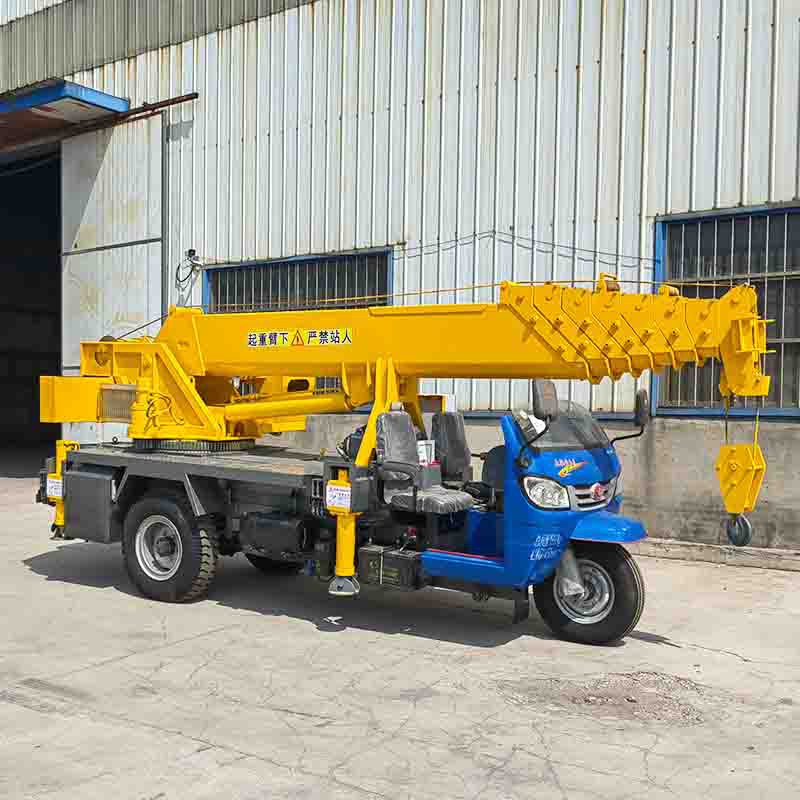
The three-wheeled crane isn't a scaled-down truck crane. It's a terrain-locked positioning tool engineered for a specific niche: delivering precision lifts in spaces where width, weight, and ground conditions rule out everything else.
1. The Engineering Trade-Off: Why Three Wheels Beat Four Here
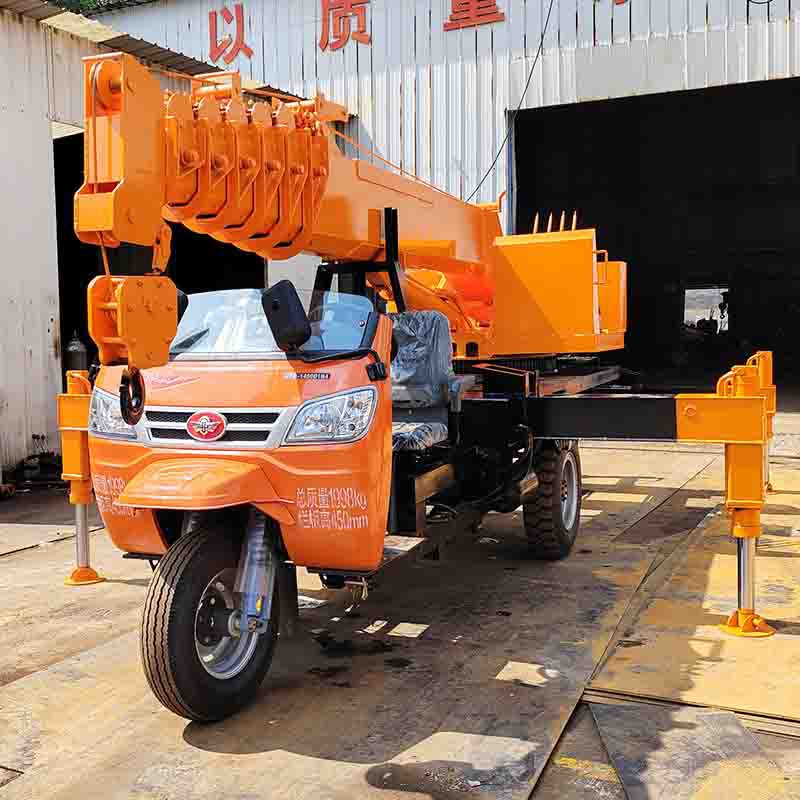
The triangular footprint isn't a cost-saving measure; it's a calculated stability solution for constrained spaces. A four-wheel chassis of similar capacity would be wider, reducing its access profile. The single steerable front wheel gives our TWC-3S a 3.2-meter turning circle-allowing it to pirouette inside a standard warehouse bay. The trade-off? A slightly narrower stability base, which is why the integrated hydraulic rear stabilizer and precise counterweighting are non-negotiable.
A Detail You Won't Find in Brochures: We use bolt-on, segmented counterweights. Why? Because on a retrofit project last year, a client needed to bring the crane through a low basement doorway. They removed 30% of the counterweight, drove through, and reattached it inside-all within 15 minutes. Modularity trumps monolithic design in the field.
The "Soft Ground" Reality: The published ground pressure (e.g., 45 kPa for the TWC-3S) is for ideal conditions. In reality, on soft turf, we instruct operators to use timber mats not just under the stabilizers, but under all three wheels to create a continuous load-bearing platform. This simple tactic expands the machine's usable terrain by over 50%.
2. Operational Economics: The Hidden Cost of "Making Do"
The business case isn't against a large crane rental; it's against the cumulative cost of workarounds.
Scenario: Installing prefabricated mechanical modules (2.8 tons each) inside an active semiconductor plant. Floor load limits prohibit forklifts, and aisles are narrow.
The "As-Is" Solution: Using gantries and chain hoists, requiring a crew of four, full aisle closure for 8 hours per module, and significant manual rigging risk.
The TWC Solution: One TWC-3S with an operator and a spotter. Aisles are closed only for the 20-minute lift cycle per module. The crane's precise inching controls allow placement within millimeters.
The Real ROI: The $25,000 machine paid for itself not in rental savings, but in reduced critical path time on that single 3-week project. The plant's project manager valued the avoided production disruption at over ten times the machine's cost.
3. Model Differentiation: It's About Ground Pressure, Not Just Tonnage
Choosing the wrong model doesn't mean it won't lift; it means it will damage the ground or get stuck. Our lineup is defined by terrain.
|
Model |
Capacity |
Key Terrain & Application |
Critical Non-Standard Option |
|---|---|---|---|
|
TWC-3S ("Site") |
3 Tons |
Finished surfaces. Indoor factories, warehouses, paved yards. Ground pressure < 50 kPa. |
Polyurethane wheels: For ultra-clean environments (food/pharma) where marking floors is unacceptable. |
|
TWC-5 ("General") |
5 Tons |
Compact sites & improved soil. Residential construction, rooftop unit placement, landscaping. |
Wide-flotation tires: For loose gravel or firm sand, increasing footprint area by 40%. |
|
TWC-8R ("Rough") |
8 Tons |
Unimproved terrain. Foundation work, laydown yards, rural installations. |
Self-recovery winch: A small front-mounted winch for extracting itself from mud-because calling a tow truck defeats the purpose. |
4. The Most Common (and Costly) Misconception
Misconception: "It's just a small crane. We can use it like a forklift to travel with a suspended load."
Reality: This is the single greatest stability risk. Traveling with a lifted load is strictly prohibited in the operator's manual for all but the lightest loads at minimal height and radius. The dynamic forces from braking or turning can instantly tip the unit. We start every training session with this rule.
5. The Pre-Purchase Checklist: Are You a Fit?
Answer these questions honestly. If you answer "No" to more than two, a three-wheeled crane might not be your optimal solution.
Is your primary challenge about maneuvering in tight spaces (width < 4m) rather than reaching extreme heights (>15m)?
Are you lifting single, discrete objects (machinery, AC units, generators) rather than continuously moving bulk material?
Do you have a trained, certified crane operator (or are you willing to train one)? This is not a forklift.
Are your typical ground conditions reasonably firm (concrete, asphalt, compacted gravel) or can you plan to use ground protection mats?
6. Next Step: Send Us Your Problem, Not an Inquiry
Don't ask for a brochure. Send us a phone photo sketch.
Draw the obstacle: a narrow gate, a finished floor, a ditch.
Mark the distances.
Circle the weight of the problem object.
With that, we can give you a definitive "Yes, here's how" or "No, here's what you should look at instead." Our goal is to fit the tool to the problem, not the other way around.
Hot Tags: three-wheeled crane, China three-wheeled crane manufacturers, factory, all terrain crane, hydraulic pickup truck crane, crawler tracks, concrete slab breaking machine, Tracked High Tip Dumper, 1 Ton Digger
You Might Also Like


Send Inquiry