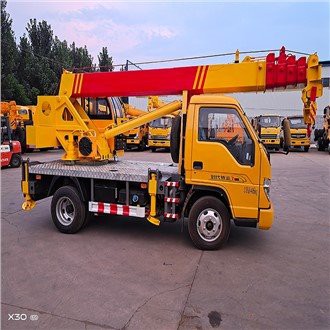
Hey there! As a supplier of Mini Crawler Cranes, I've been getting a lot of questions lately about the ground pressure exerted by these machines. So, I thought I'd break it down in this blog post and give you all the info you need.
First off, let's talk about why ground pressure matters. When you're using a crane, especially in construction or industrial settings, the ground has to support the weight of the crane and whatever it's lifting. If the ground pressure is too high, it can cause damage to the surface, like cracking or sinking, and it can also make the crane unstable. That's a big no - no when you're working with heavy loads!
A Mini Crawler Crane is a great option for many jobs because it's more compact and can operate in tighter spaces compared to larger cranes. But even though it's small, it still exerts ground pressure, and understanding this is crucial for safe and efficient operation.
The ground pressure of a Mini Crawler Crane is calculated by dividing the total weight of the crane (including any attached equipment and the load it's carrying) by the area of the crawler tracks in contact with the ground. Mathematically, it's expressed as:
Ground Pressure (P) = Total Weight (W) / Contact Area (A)
Let's say our Mini Crawler Crane weighs around 5 tons (including its basic configuration). If the combined area of the crawler tracks in contact with the ground is, for example, 2 square meters. First, we need to convert the weight from tons to kilograms (since 1 ton = 1000 kg, 5 tons = 5000 kg), and then calculate the pressure. The gravitational force related to the weight (F =mg, where g is approximately 9.81 m/s²) is F = 5000 kg×9.81 m/s² = 49050 N.
The ground pressure P = 49050 N / 2 m² = 24525 Pa. In practical terms, this means that every square meter of the ground is being pushed on with a force of 24525 Newtons.
Now, different surfaces can handle different levels of ground pressure. For instance, a solid concrete surface can withstand much higher pressure compared to soft soil or grass. If you're working on a soft surface, you might need to take extra precautions. One option is to use ground mats. These are large, flat panels that you place under the crawler tracks. They increase the contact area (A) in our formula, which in turn reduces the ground pressure.
Let's compare the Mini Crawler Crane with some other types of cranes. The Tractor Platform Crane is often used in construction sites and can be quite heavy. Since it's usually on a wheeled platform, the ground pressure is concentrated on a smaller contact area compared to a crawler crane. This means that on soft ground, a tractor - platform crane might have more issues with sinking than a Mini Crawler Crane.
The Rough Terrain Crane is designed for work on uneven or rough ground. It's a powerful machine, but its ground pressure can also vary depending on its load and the type of tires or tracks it has. In some cases, a rough - terrain crane might need to be more carefully positioned on the ground to avoid excessive pressure in one area.
Another interesting piece of equipment is the Forklift Boom. While it's not exactly a crane, it can be used for lifting tasks. The ground pressure of a forklift with a boom attachment depends on the weight of the forklift, the load on the boom, and the size of the forklift's tires. Similar to other lifting equipment, if the ground pressure is too high, it can cause problems for the forklift's stability and the integrity of the ground.
As a Mini Crawler Crane supplier, I know that choosing the right crane for your job is essential. You need to consider not only the lifting capacity but also the ground conditions. If you're working in an area with sensitive ground, like a historical site or a newly constructed floor, a Mini Crawler Crane can be a great choice because you can manage its ground pressure more easily.


We've also been constantly improving our Mini Crawler Cranes to make them more efficient and user - friendly. For example, we're working on designs that reduce the overall weight of the crane without sacrificing its lifting capacity. This directly affects the ground pressure, making it even more suitable for a wider range of ground conditions.
If you're in the market for a Mini Crawler Crane, or if you have any questions about ground pressure or other aspects of these machines, don't hesitate to reach out. We're here to help you make the best decision for your project. Whether you're a small construction company or a large industrial firm, we can provide the right Mini Crawler Crane to meet your needs.
In conclusion, understanding the ground pressure exerted by a Mini Crawler Crane is vital for safe and successful operation. By knowing how to calculate it and take appropriate measures, you can ensure that your crane works efficiently without causing damage to the ground or compromising its stability. So, if you're ready to take your lifting operations to the next level, consider a Mini Crawler Crane from us.
References:
- Engineering Mechanics textbooks for basic pressure and force calculations.
- Crane operation manuals for specific details about different crane models.