What are the outreach limits of an offshore crane?
As a seasoned supplier of offshore cranes, I've witnessed firsthand the critical role these machines play in offshore operations. Offshore cranes are engineering marvels designed to withstand the harsh conditions of the open sea while performing heavy - lifting tasks with precision. One of the most crucial aspects of an offshore crane is its outreach limit, which significantly impacts its functionality and application.
The outreach of an offshore crane refers to the horizontal distance from the center of rotation of the crane to the hook. It determines how far the crane can reach to pick up or place a load. Understanding the outreach limits is essential for both the design and operation of offshore cranes, as it directly affects the efficiency and safety of offshore projects.
Factors Affecting Outreach Limits
Structural Design
The structural design of the crane is a primary factor influencing its outreach limit. The boom length, for instance, is a key determinant. A longer boom generally allows for a greater outreach. However, as the boom extends, it becomes more susceptible to bending and deflection under the weight of the load. To counteract this, cranes are equipped with complex support structures and hydraulic systems. For example, lattice - boom cranes are often used in offshore applications because their lattice structure provides high strength - to - weight ratio, enabling them to achieve greater outreaches compared to other types of booms.


Load Capacity
The load capacity and outreach have an inverse relationship. As the outreach increases, the crane's ability to lift heavy loads decreases. This is because the moment created by the load (the product of the load weight and the outreach distance) must be within the crane's design limits. For instance, a crane with a large load capacity at a short outreach may only be able to lift a fraction of that load at its maximum outreach. This relationship is typically represented in load charts provided by crane manufacturers, which are essential tools for crane operators to ensure safe operation.
Environmental Conditions
The harsh offshore environment also has a significant impact on the outreach limits of a crane. High winds, waves, and sea currents can create additional forces on the crane and the load. Strong winds, in particular, can cause the boom to sway and the load to oscillate, reducing the crane's stability and effective outreach. In extreme weather conditions, the crane may need to reduce its outreach or even cease operations to avoid accidents.
Different Types of Offshore Cranes and Their Outreach Limits
Marine Crane
Marine Crane is a type of offshore crane commonly used on ships and offshore platforms. These cranes are designed to handle various types of loads, from small equipment to large containers. The outreach limits of marine cranes can vary widely depending on their size and design. Smaller marine cranes may have outreaches of a few meters, while larger ones used on major offshore platforms can reach up to tens of meters. Their design often takes into account the need for stability in a marine environment, with features such as anti - roll devices and shock - absorbing systems.
Three - wheeled Crane
Three - wheeled Crane is another type that can be used in certain offshore applications. These cranes are known for their mobility and relatively compact size. However, their outreach limits are generally more restricted compared to larger, fixed - base offshore cranes. The three - wheeled design provides a certain degree of flexibility, but it also limits the structural support for long - distance outreaches. Typically, three - wheeled cranes used in offshore settings may have outreaches in the range of a few meters to around 10 - 15 meters.
Small Truck Crane
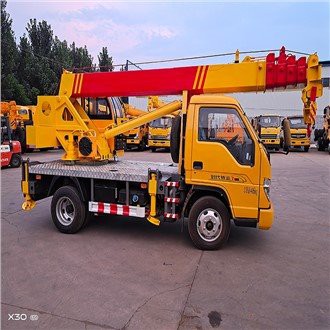
Small Truck Crane can also find its way into some offshore operations, especially in areas where space is limited or for lighter - duty tasks. These cranes are often transported to the offshore site on trucks and then set up for operation. Their outreach is usually limited due to their smaller size and load - bearing capacity. Outreaches for small truck cranes in offshore applications may range from 5 - 15 meters, depending on the specific model and configuration.
Importance of Understanding Outreach Limits in Offshore Projects
In offshore projects, such as oil and gas exploration, wind farm installation, and marine construction, understanding the outreach limits of cranes is crucial for project planning and execution. Incorrect assessment of outreach limits can lead to delays, increased costs, and even safety hazards.
During the planning phase, project managers need to select the appropriate crane based on the required outreach and load capacity. They must consider factors such as the distance between the crane location and the load - handling points, the weight and size of the loads, and the expected environmental conditions. This ensures that the crane can perform the required tasks efficiently and safely.
During operation, crane operators must strictly adhere to the outreach limits specified in the load charts. Deviating from these limits can result in overloading the crane, which may lead to structural failure, dropped loads, and other serious accidents. Regular inspections and maintenance of the crane are also essential to ensure that its outreach capabilities remain within the design specifications.
Conclusion
In conclusion, the outreach limits of an offshore crane are determined by a combination of factors, including structural design, load capacity, and environmental conditions. Different types of offshore cranes, such as Marine Crane, Three - wheeled Crane, and Small Truck Crane, have varying outreach capabilities based on their specific designs and intended applications.
As an offshore crane supplier, we understand the importance of providing accurate information about outreach limits to our customers. Our team of experts can assist you in selecting the right crane for your offshore project, taking into account all the relevant factors. Whether you are involved in a large - scale oil and gas development or a small - scale marine construction project, we have the expertise and the range of cranes to meet your needs.
If you are interested in learning more about our offshore cranes or would like to discuss your specific requirements, please do not hesitate to contact us. We are eager to engage in procurement discussions and help you find the best crane solutions for your offshore operations.
References
- AISC (American Institute of Steel Construction). (2017). Specification for Structural Steel Buildings.
- API (American Petroleum Institute). (2014). Recommended Practice for Planning, Designing, and Constructing Fixed Offshore Platforms - Working Stress Design.
- ISO (International Organization for Standardization). (2018). ISO 13852:2018 - Cranes — Safety — Lifting appliances for offshore installations.