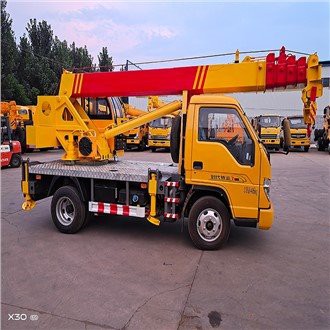
As a trusted supplier of truck cranes, I often encounter inquiries from customers about the intricate workings of various components in these powerful machines. One question that frequently arises is, "How does the slewing mechanism work in a truck crane?" In this blog post, I will delve into the details of the slewing mechanism, explaining its function, components, and operation.


Understanding the Role of the Slewing Mechanism
The slewing mechanism is a crucial part of a truck crane, enabling the crane's upper structure, including the boom and the load, to rotate horizontally. This rotation capability is essential for positioning the load accurately at the desired location. Whether it's a construction site, a shipping yard, or any other lifting operation, the ability to slew the crane allows for greater flexibility and efficiency in handling loads.
Components of the Slewing Mechanism
The slewing mechanism consists of several key components, each playing a vital role in its operation. These components include:
- Slewing Ring: The slewing ring is a large bearing that connects the upper structure of the crane to the lower chassis. It provides a smooth and stable platform for rotation. The slewing ring typically has internal or external gears that mesh with the slewing drive.
- Slewing Drive: The slewing drive is a gearbox that contains a motor and a set of gears. The motor provides the power to rotate the slewing ring, and the gears transmit the power from the motor to the slewing ring. The slewing drive is usually mounted on the upper structure of the crane.
- Control System: The control system of the slewing mechanism allows the operator to control the rotation of the crane. It typically includes a control panel, joystick, or other input devices that send signals to the slewing drive to start, stop, or change the direction of rotation.
- Braking System: The braking system is an important safety feature of the slewing mechanism. It is designed to hold the crane in position when it is not rotating and to prevent it from rotating unexpectedly. The braking system can be either mechanical or hydraulic, depending on the design of the crane.
How the Slewing Mechanism Works
The operation of the slewing mechanism can be divided into several steps:
- Power Input: When the operator activates the control system, the motor in the slewing drive starts to rotate. The motor converts electrical or hydraulic energy into mechanical energy, which is then transmitted to the gears in the slewing drive.
- Gear Transmission: The gears in the slewing drive transmit the power from the motor to the slewing ring. The gears are designed to provide the appropriate torque and speed for the rotation of the crane. The ratio of the gears determines the speed and torque of the rotation.
- Rotation of the Slewing Ring: As the gears in the slewing drive rotate, they mesh with the gears on the slewing ring. This causes the slewing ring to rotate, along with the upper structure of the crane. The rotation can be in either a clockwise or counterclockwise direction, depending on the signals sent by the control system.
- Braking and Positioning: When the operator wants to stop the rotation of the crane, they activate the braking system. The braking system applies a force to the slewing ring, preventing it from rotating. This allows the crane to be positioned accurately at the desired location.
Types of Slewing Mechanisms
There are several types of slewing mechanisms used in truck cranes, each with its own advantages and disadvantages. The most common types include:
- Hydraulic Slewing Mechanism: Hydraulic slewing mechanisms use hydraulic fluid to transmit power from the motor to the slewing ring. They are known for their high torque and smooth operation. Hydraulic slewing mechanisms are often used in larger truck cranes that require more power.
- Electric Slewing Mechanism: Electric slewing mechanisms use an electric motor to drive the slewing ring. They are more energy-efficient and quieter than hydraulic slewing mechanisms. Electric slewing mechanisms are commonly used in smaller truck cranes and in applications where noise is a concern.
- Mechanical Slewing Mechanism: Mechanical slewing mechanisms use a system of gears and shafts to transmit power from the motor to the slewing ring. They are simple and reliable, but they may not be as efficient as hydraulic or electric slewing mechanisms. Mechanical slewing mechanisms are often used in older truck cranes or in applications where cost is a major factor.
Applications of Truck Cranes with Slewing Mechanisms
Truck cranes with slewing mechanisms are used in a wide range of applications, including:
- Construction: Truck cranes are commonly used in construction sites to lift and move heavy materials, such as steel beams, concrete blocks, and prefabricated components. The slewing mechanism allows the crane to position the load accurately at the desired location, even in tight spaces.
- Shipping and Logistics: In shipping yards and ports, truck cranes are used to load and unload cargo from ships and trucks. The slewing mechanism enables the crane to reach different areas of the ship or truck, making the loading and unloading process more efficient.
- Mining and Quarrying: In mining and quarrying operations, truck cranes are used to lift and move heavy equipment, such as crushers, conveyors, and drilling rigs. The slewing mechanism allows the crane to access different parts of the mining site, improving productivity and safety.
- Emergency Response: Truck cranes are also used in emergency response situations, such as natural disasters and accidents. The slewing mechanism enables the crane to quickly and accurately position rescue equipment and supplies, helping to save lives and reduce damage.
Conclusion
The slewing mechanism is a critical component of a truck crane, enabling it to rotate horizontally and position the load accurately. Understanding how the slewing mechanism works is essential for operators, maintenance personnel, and anyone involved in the operation of truck cranes. By choosing the right type of slewing mechanism and ensuring proper maintenance, you can ensure the safe and efficient operation of your truck crane.
If you are in the market for a truck crane or need more information about our products, we invite you to explore our website. We offer a wide range of truck cranes, including Tractor Platform Crane, Offshore Crane, and Truck-mounted Crane Track. Our team of experts is ready to assist you in selecting the right crane for your specific needs. Contact us today to start the procurement process and take your lifting operations to the next level.
References
- "Crane Handbook: Operation, Maintenance, and Safety" by David Blockley
- "Truck Cranes: Design, Operation, and Maintenance" by John Smith
- Manufacturer's manuals and technical documentation for truck cranes