What is the crane's ground pressure when fully loaded?
As a supplier of Mini Caterpillar Cranes, understanding the ground pressure of a crane when fully loaded is crucial for both safety and operational efficiency. Ground pressure is defined as the force exerted by the crane on the ground surface per unit area. It is a key factor that determines the stability of the crane during lifting operations.
The Basics of Ground Pressure Calculation
The ground pressure of a crane can be calculated using the formula: Ground Pressure (P) = Total Load (F) / Contact Area (A). The total load includes the weight of the crane itself, the load it is carrying, and any additional equipment or counterweights. The contact area is the area of the crane's outriggers or tracks that are in contact with the ground.

For example, if a fully - loaded Mini Caterpillar Crane has a total weight of 10,000 kg (equivalent to a force of F = 10,000 kg × 9.81 m/s² = 98,100 N, where 9.81 m/s² is the acceleration due to gravity), and the total contact area of its tracks is 2 m², then the ground pressure is P = 98,100 N / 2 m² = 49,050 Pa or 49.05 kPa.
Factors Affecting Ground Pressure
- Crane Design and Configuration
- Different types of cranes have different contact areas. Mini Caterpillar Cranes, with their caterpillar tracks, generally have a larger contact area compared to some other types of cranes. This larger contact area helps to distribute the load more evenly and reduces the ground pressure. In contrast, cranes with outriggers may have a smaller contact area when the outriggers are fully extended, which can increase the ground pressure at the outrigger points.
- Load Capacity
- The heavier the load a crane is carrying, the higher the ground pressure. When a Mini Caterpillar Crane is fully loaded, the additional weight of the load significantly increases the total force exerted on the ground. For instance, if a crane is designed to lift a maximum load of 5 tons, when it is actually lifting this full - capacity load, the ground pressure will be much higher than when it is operating with a lighter load or no load at all.
- Ground Conditions
- The type of ground surface also plays a vital role. Soft or unstable ground, such as muddy soil or sand, cannot withstand high ground pressures. Even if a crane has a relatively low ground pressure calculation, it may still sink or become unstable on soft ground. On the other hand, hard surfaces like concrete or asphalt can generally support higher ground pressures.
Importance of Controlling Ground Pressure
- Safety
- Maintaining an appropriate ground pressure is essential for the safety of the crane operators and the surrounding environment. If the ground pressure exceeds the bearing capacity of the ground, the crane may tip over, causing serious accidents. For example, in construction sites where there are workers and other equipment in the vicinity, a crane accident due to excessive ground pressure can lead to injuries, property damage, and even loss of life.
- Equipment Longevity
- Excessive ground pressure can also damage the crane itself. High - pressure points can cause wear and tear on the crane's tracks or outriggers. For a Mini Caterpillar Crane, if the ground pressure is too high, it can lead to premature damage of the track links, reducing the lifespan of the crane and increasing maintenance costs.
Comparison with Other Types of Cranes
- Diesel Truck Mounted Crane With Three Wheels
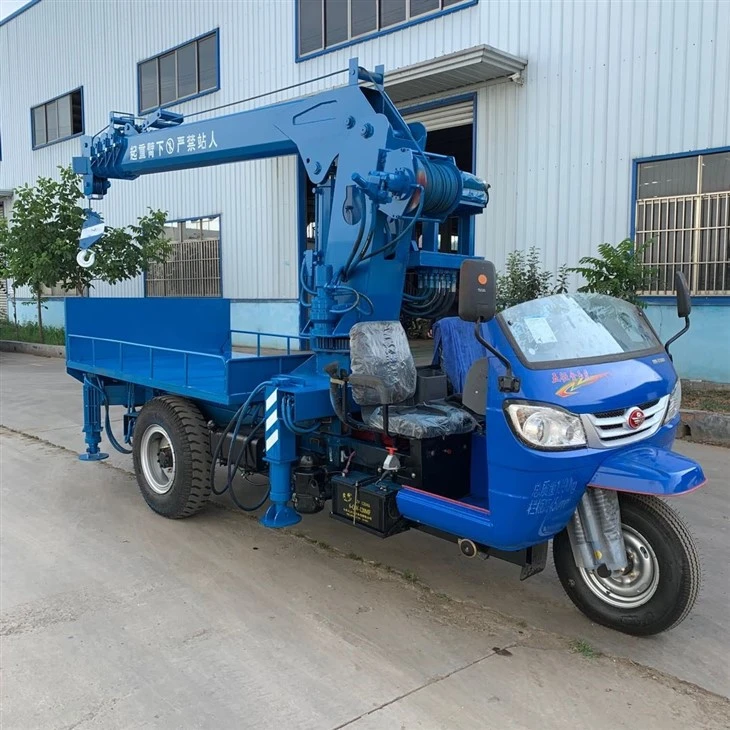
- Diesel truck - mounted cranes with three wheels typically have a different load - distribution mechanism. They rely on the truck's wheels for support. The contact area of the wheels is relatively small compared to the tracks of a Mini Caterpillar Crane. As a result, when fully loaded, the ground pressure at the wheel - ground contact points can be quite high. This means that they may require more stable ground conditions or additional support, such as using outriggers, to operate safely.
- Ship Crane
- Ship cranes are designed to operate on the deck of a ship. The ground (deck) conditions are different from those on land. The deck of a ship is usually a relatively flat and strong surface, but the crane still needs to be designed to distribute its load properly. Ship cranes often have a large base area to ensure stability in the marine environment. Compared to a Mini Caterpillar Crane, the ground pressure considerations for ship cranes are more related to the structural integrity of the ship's deck and the dynamic forces during ship movement.
- Spider Crane
- Spider cranes are known for their flexibility and ability to access tight spaces. They have multiple outriggers that can be adjusted to different positions. When fully extended, the outriggers can provide a wide base for stability. However, at the outrigger tips, the contact area is relatively small, which can result in high ground pressure if not properly managed. Mini Caterpillar Cranes, with their continuous track system, generally have a more evenly distributed ground pressure compared to spider cranes.
How Our Mini Caterpillar Cranes Manage Ground Pressure
Our Mini Caterpillar Cranes are designed with ground pressure management in mind. The caterpillar tracks are engineered to provide a large contact area, which helps to distribute the load evenly. This design feature allows our cranes to operate on a variety of ground conditions, including soft and uneven terrain, with reduced risk of sinking or instability.
In addition, we offer optional features such as track pads that can further increase the contact area and reduce ground pressure. These track pads can be easily attached to the tracks, providing an extra layer of protection for the ground surface and improving the crane's performance in challenging environments.
Conclusion
Understanding the ground pressure of a crane when fully loaded is essential for safe and efficient operation. As a supplier of Mini Caterpillar Cranes, we are committed to providing our customers with cranes that are designed to manage ground pressure effectively. Our cranes offer a combination of high load - capacity and low ground pressure, making them suitable for a wide range of applications.
If you are interested in learning more about our Mini Caterpillar Cranes or have specific requirements regarding ground pressure and crane operations, we encourage you to contact us for further discussion and potential procurement. Our team of experts is ready to assist you in finding the right crane solution for your needs.
References
- "Crane Design and Safety Standards" - International Crane Manufacturers Association
- "Ground Bearing Capacity and Crane Operations" - Construction Equipment Handbook