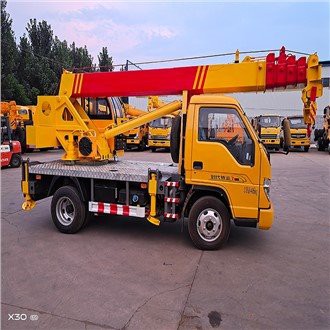
Hey there! I'm a supplier of small truck cranes, and today I wanna chat about how to measure the performance of these nifty machines. Small truck cranes are super handy in all sorts of jobs, from construction sites to small - scale material handling. So, getting a good grasp of their performance is crucial for both us suppliers and you buyers.
Lifting Capacity
First off, the most obvious factor is the lifting capacity. This is basically how much weight the crane can safely hoist. It's measured in tons or kilograms, depending on where you are in the world. When we talk about lifting capacity, we're not just looking at the maximum weight it can handle under ideal conditions. You've got to consider different boom lengths and angles too.
For example, a small truck crane might have a maximum lifting capacity of 5 tons when the boom is fully retracted. But as you extend the boom, that capacity drops. This is because the longer the boom, the more leverage it creates, and the more stress it puts on the crane's structure. So, if you're working on a job that requires lifting heavy loads at a distance, you need to make sure the crane can handle it at that specific boom length.
You can find the lifting capacity charts in the crane's manual. These charts show you the relationship between boom length, boom angle, and the maximum safe lifting weight. It's essential to follow these charts to avoid overloading the crane, which can lead to accidents and damage. If you're ever in doubt, don't hesitate to ask us suppliers. We're here to help you pick the right crane for your needs.
Lifting Height and Radius
Lifting height and radius are also key performance indicators. The lifting height is how high the crane can lift a load, and the radius is how far horizontally the load can be moved from the center of the crane.
A small truck crane with a longer boom will generally have a greater lifting height and radius. But again, these values change depending on the boom angle and the load being lifted. When you're planning a job, you need to know the exact height and radius requirements. For instance, if you're working on a multi - story building and need to lift materials to the top floor, you'll need a crane with sufficient lifting height.
Let's say you're building a small shed and need to move materials from one side of the site to the other. You'll need to consider the crane's radius to ensure it can reach all the necessary areas. We can provide you with cranes that have different boom lengths and configurations to meet your specific height and radius needs.
Lifting Speed
Lifting speed is another important aspect. How quickly the crane can lift and lower a load can have a big impact on productivity. A faster - lifting crane can get more work done in less time, which is great for meeting deadlines.
However, speed isn't everything. You also need to consider the smoothness of the lift. A crane that jerks or moves unevenly can damage the load or cause safety issues. Our small truck cranes are designed to offer a good balance between speed and smooth operation. We use high - quality hydraulic systems that allow for precise control of the lifting speed.
You can adjust the lifting speed according to the load and the job requirements. For lighter loads, you can increase the speed to get the job done faster. But for heavier or more delicate loads, you might want to slow it down to ensure a safe and stable lift.
Mobility
Since these are truck cranes, mobility is a major performance factor. The ability to move the crane easily from one job site to another is crucial. Our small truck cranes are designed to be highly mobile. They can be driven on public roads, which makes it convenient to transport them between different locations.


The truck's engine power and the crane's overall weight distribution play a role in its mobility. A powerful engine allows the crane to move quickly and handle different terrains. And a well - balanced weight distribution ensures stability while driving.
We offer different types of small truck cranes, each with its own mobility features. For example, our [Rough Terrain Crane](/engineering - plant/truck - crane/rough - terrain - crane.html) is designed to operate on uneven and rough surfaces. It has large, sturdy tires and a robust suspension system that can handle tough terrains. On the other hand, our [Diesel Three - wheeled Crane](/engineering - plant/truck - crane/diesel - three - wheeled - crane.html) is more compact and maneuverable, making it ideal for tight spaces.
Stability
Stability is non - negotiable when it comes to crane performance. A stable crane is a safe crane. There are several factors that affect stability, such as the crane's base size, the outriggers, and the load distribution.
The base of the crane provides a solid foundation. A wider base generally means more stability. Our small truck cranes are designed with a wide base to ensure maximum stability during operation. Outriggers are also crucial. These are extendable arms that provide additional support when the crane is lifting a load. They can be adjusted to level the crane on uneven surfaces.
Proper load distribution is also important. The load should be centered over the crane's base to avoid tipping. Our cranes come with safety features that help ensure proper load distribution. For example, some of our models have load moment indicators that show you if the load is within the safe limits.
Fuel Efficiency
In today's world, fuel efficiency is a big deal. A fuel - efficient crane can save you a lot of money in the long run. Our small truck cranes are designed with fuel - saving technologies. We use advanced engine management systems that optimize fuel consumption based on the load and the operating conditions.
For example, when the crane is idle or lifting a light load, the engine can operate at a lower power setting, which reduces fuel consumption. And when it needs to lift a heavy load, the engine can provide the necessary power. This way, you're not wasting fuel when you don't need to.
Operator Comfort and Controls
Let's not forget about the operator. A comfortable and well - equipped operator is more likely to perform well. Our small truck cranes are designed with the operator in mind. The cabs are spacious and comfortable, with adjustable seats and good visibility.
The controls are also user - friendly. We use intuitive joystick controls that allow the operator to precisely control the crane's movements. This makes it easier for operators, even those with less experience, to operate the crane safely and efficiently.
Maintenance and Durability
Finally, maintenance and durability are important performance factors. A crane that requires frequent and costly maintenance can quickly eat into your profits. Our small truck cranes are built to last. We use high - quality materials and components that are resistant to wear and tear.
We also provide easy - to - follow maintenance schedules and manuals. Regular maintenance is essential to keep the crane in top condition. By following the maintenance guidelines, you can extend the lifespan of the crane and avoid unexpected breakdowns.
So, there you have it! These are the main factors to consider when measuring the performance of a small truck crane. If you're in the market for a small truck crane, or if you have any questions about the performance of our cranes, don't hesitate to reach out. We're here to help you find the perfect crane for your needs and ensure you get the best performance out of it. Whether you're looking for an [Offshore Crane](/engineering - plant/truck - crane/offshore - crane.html) for marine applications or a [Rough Terrain Crane](/engineering - plant/truck - crane/rough - terrain - crane.html) for tough land jobs, we've got you covered. Let's have a chat and see how we can work together!
References
- Crane Manufacturer's Manuals
- Industry Standards for Small Truck Cranes